PT Infomedia Nusantara, a subsidiary of Telkom Indonesia, provides Business Process Outsourcing solutions focused on Customer Relationship Management and Shared Service Operations.
After using digital marketing mainly to build awareness between 2021 and 2023, Infomedia shifted its priorities in 2024. The company needed to become easier to find on Google, generate more qualified leads, and drive traffic to both its corporate website and web store.
Suitmedia partnered with Infomedia between 2024 and 2025 to build a connected digital marketing program across search, social media, email, WhatsApp, SMS, and online media.
The work combined monthly content production, SEO-friendly articles, search marketing, platform-specific social content, performance measurement, and continuous optimization. The goal was not simply to increase activity online. It was to create a repeatable system that could turn visibility into engagement, website traffic, and potential business opportunities.
A Recognized Business Needed to Become Easier to Find and Choose
1. Awareness had to progress toward measurable demand
Infomedia had already invested in digital marketing activities and partnerships to increase brand awareness. That work helped establish a presence, but the company’s 2024 objectives required a more direct connection between communication and business outcomes.
The focus shifted toward two practical questions:
- Could potential customers find Infomedia when searching for relevant solutions?
- Once they found the company, would they have a clear reason to engage or make contact?
This was a meaningful change in direction. Awareness creates familiarity, but it does not necessarily create leads. Infomedia needed to build the digital conditions that could move audiences from seeing the brand to considering its services.
2. Search visibility was critical in a competitive B2B category
Infomedia operated in a specialized B2B market involving customer management and shared services. Prospective clients may search for solutions using different terms depending on their industry, business problem, or level of knowledge.
They might not search directly for Infomedia. Instead, they might look for customer service outsourcing, contact center solutions, shared service support, or ways to improve customer operations.
If Infomedia did not appear prominently for these searches, the company risked being overlooked before a sales conversation could even begin.
The company therefore aimed to reach Google’s first page and improve visibility across relevant searches. This required consistent content, a technically sound website, and a clear relationship between search terms and the services Infomedia offered.
3. Traffic would not be enough without lead potential
Increasing website and web store traffic was an important goal, but traffic alone does not guarantee business value.
Visitors need to arrive with relevant intent, understand the offer, and find an appropriate next step. A large number of visits from people who are not potential customers may create activity without creating opportunity.
Infomedia needed digital marketing that attracted the right audiences and gave them reasons to continue exploring.
This meant aligning content topics, search campaigns, social communication, and calls to action with the customer’s path from awareness to consideration.
4. The company needed to communicate across different digital behaviors
Infomedia’s audiences did not all use the same channel in the same way.
LinkedIn could support professional and business-oriented communication. Instagram could present the brand through more visual and accessible content. Facebook, TikTok, and Twitter could support broader awareness and interaction.
Email, WhatsApp, and SMS could help reach existing contacts or audiences who had already shown interest. Search and the website could capture people actively looking for relevant services.
Each channel had a different role. Treating them identically would reduce their effectiveness and make the brand feel less natural in each environment.
5. Consistency was difficult to maintain at scale
Infomedia required 24 social media content pieces each month and 20 SEO-friendly articles each month.
This production volume created an operational challenge. Content had to be original, accurate, aligned with Infomedia’s persona, and adapted to the audience and format of each channel.
High output without a clear process can result in repetitive ideas, inconsistent tone, weak quality control, or content that is published without a clear objective.
The work therefore needed a system that connected planning, production, review, distribution, and measurement.
6. Lead generation needed evidence and adjustment
Digital marketing performance can change based on audience behavior, platform algorithms, search competition, timing, and content quality.
Infomedia could not rely on a fixed campaign plan and assume it would remain effective. The team needed to monitor engagement, traffic, search visibility, and response patterns to identify what was working.
The program required continuous improvement. Content and campaigns needed to produce learning that could inform the next month’s decisions.
Building an Integrated System for Search, Content, and Conversion
1. We began by connecting business goals with channel roles
Suitmedia built the program around Infomedia’s main objectives: stronger search visibility, qualified lead generation, website and web store traffic, and increased social engagement.
Each channel was assigned a practical role:
- SEO content helped Infomedia become discoverable through organic search.
- SEM and digital campaigns supported visibility for targeted searches and commercial priorities.
- Social media built awareness, explained services, and encouraged interaction.
- Email, WhatsApp, and SMS created direct communication opportunities.
- The website and web store provided destinations where audiences could learn more and take action.
This prevented the campaign from becoming a collection of disconnected activities. The channels worked toward a shared customer journey.
2. We created a monthly content operating rhythm
The work included a monthly content strategy, social media calendar, and planned production schedule.
Suitmedia developed 24 social media content pieces each month and delivered them to Infomedia’s Marketing Communications team for review.
This workflow created a clear division of responsibility. Suitmedia supported planning, creation, and performance improvement, while Infomedia reviewed originality and ensured that each piece matched the company’s persona and tone of voice.
A defined review process was important for a B2B services company. Content needed to be engaging, but it also had to remain accurate, credible, and aligned with how Infomedia wanted to present itself.
3. We produced SEO content consistently rather than occasionally
Suitmedia created 20 SEO-friendly articles each month.
This volume supported a long-term search strategy. Search visibility generally depends on more than one strong article. It requires a growing body of useful content that addresses different questions and creates more entry points into the website.
The articles were developed to improve Infomedia’s relevance for search queries related to its services and areas of expertise.
Consistency also created a compounding effect. Each useful article had the potential to attract organic visitors over time, while collectively the content could strengthen the website’s authority and coverage across relevant topics.
4. We developed content around audience needs and business questions
SEO content could not be based only on adding keywords to pages.
The articles needed to address topics that mattered to Infomedia’s audiences and connect those topics to the company’s capabilities.
This required considering what potential customers might want to understand before contacting a BPO or shared services provider. They may need explanations of operational challenges, customer management approaches, service models, or business benefits.
Content that answers these questions helps potential customers evaluate the category and positions Infomedia as a useful source of information.
This was important for lead generation because people often need education before they are ready to make an inquiry.
5. We tailored content to each social platform
Suitmedia adapted communication according to the behavior of each platform.
Instagram content could use strong visual presentation, short videos, carousels, and interactive formats to attract attention and make the brand more approachable.
LinkedIn content could focus more directly on business value, professional insights, company achievements, and industry relevance.
Facebook and other channels could support broader communication, announcements, and audience interaction. The same core message could be expressed differently depending on where users encountered it.
This improved the likelihood that content would feel native to the platform rather than copied across every channel.
6. We used interactive content to create participation
The program included interactive quizzes using multiple-choice questions.
This format gave audiences a simple way to respond. Users did not need to read a long explanation or complete a complex form before participating.
Quizzes also gave Infomedia a way to make business topics more accessible. A question could introduce a concept, test knowledge, or encourage audiences to think about a problem related to customer management and business operations.
The activity created a shift from one-way communication to participation. That interaction helped deepen attention and provided a clearer signal that audiences were engaging with the content.
7. We used varied formats to avoid a repetitive content experience
The social media program included static images, carousels, videos, articles, interactive quizzes, and corporate updates.
Different formats served different communication needs. Static content could deliver a focused message. Carousels could explain several points in sequence. Videos could show people, processes, or ideas more dynamically. Articles could provide greater depth.
This variety helped maintain audience interest and allowed Infomedia to communicate both its business expertise and its corporate identity.
The important principle was not to use every format simply for variety. Each format was selected according to what the message needed to accomplish.
8. We used company achievements and important moments to strengthen the brand
The content program included major-day celebrations and company achievements.
These posts helped present Infomedia as an active organization with a clear identity and ongoing contribution.
Corporate content can sometimes feel disconnected from audience needs, but it plays an important role in building familiarity and trust. It shows the people and moments behind the service business.
By combining corporate updates with educational, interactive, and service-related content, Infomedia could communicate both what it did and who it was.
9. We managed distribution across multiple digital channels
The integrated strategy covered Instagram, Facebook, LinkedIn, TikTok, Twitter, WhatsApp, SMS, and email.
This multi-channel approach gave Infomedia more opportunities to reach audiences at different stages of interest.
Social media could create awareness and interaction. Email and direct messaging could support more targeted communication. Search could capture active demand. The website and web store could provide deeper information and conversion paths.
The key was coordination. The brand needed to remain recognizable across channels while adapting the message to each environment.
10. We combined SEO with SEM to support both long- and short-term visibility
Organic search can build durable visibility, but it often takes time to develop.
SEM and paid search provided a way to support visibility for targeted terms while SEO content continued to grow the website’s organic presence.
Using both approaches helped Infomedia address immediate campaign needs without abandoning long-term search development.
The combination also created useful learning. Paid search data could reveal which terms and messages attracted interest, while organic performance could show which topics continued to generate attention over time.
11. We monitored and measured performance continuously
Suitmedia tracked content and campaign results to identify where engagement and traffic were developing.
Measurement supported decisions about future content topics, formats, timing, and channel priorities.
This was especially important given the volume of monthly content. Without performance review, producing 24 social posts and 20 articles each month could become an exercise in output rather than improvement.
Analytics helped connect activity to response and made it possible to refine the program based on evidence.
12. We maintained content quality through client review
Before content was published, Infomedia’s Marketing Communications team reviewed it for originality and alignment with the company’s persona and tone of voice.
This process protected brand consistency and helped ensure that content reflected Infomedia accurately.
It also made the work collaborative. Suitmedia contributed digital marketing expertise and production capacity, while Infomedia contributed business knowledge and brand judgment.
The result was a stronger balance between speed and accuracy.
From Digital Activity to Stronger Visibility and Engagement
1. Infomedia expanded its Instagram audience
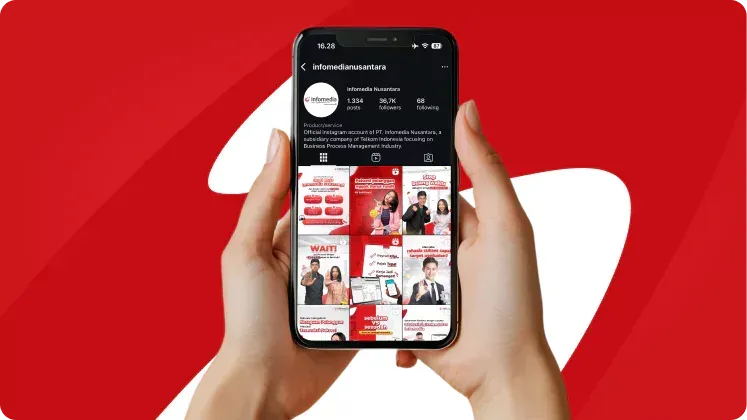
Infomedia’s Instagram activity attracted 3,347 new followers and generated 6,139 total engagements.
The reported engagement rate reached 500%, reflecting strong interaction according to the campaign’s measurement system.
These results indicate that the content strategy was successful in attracting attention and encouraging audience response on Instagram.
The value was not only the increase in followers. A larger and more engaged audience gave Infomedia a stronger base for future product communication, corporate updates, and campaign activity.
2. LinkedIn supported professional audience engagement
Infomedia’s LinkedIn presence reached 5,555 followers and recorded 256 engagements.
LinkedIn played an important role because Infomedia operates in a B2B services market. Professional audiences may use the platform to understand a company’s expertise, business relevance, achievements, and perspective on industry issues.
The content helped Infomedia maintain a presence in a professional environment while supporting broader brand visibility.
The results also demonstrated why platform-specific communication matters. Engagement expectations and audience behavior on LinkedIn differ from those on Instagram, so performance should be interpreted in context.
3. Search visibility improved through sustained content production
Publishing 20 SEO-friendly articles each month contributed to increased search visibility and organic traffic.
The content program gave Infomedia more opportunities to appear for relevant queries and helped improve the website’s relevance across its areas of expertise.
Organic search growth is cumulative. Individual articles may attract different levels of traffic, but a consistent library can create a stronger overall presence and continue generating visits after publication.
This gave Infomedia a more durable source of discovery than campaign activity alone.
4. The website and web store gained stronger support from digital channels
Social media, search, and direct messaging created more routes toward Infomedia’s website and web store.
This helped connect audience attention with deeper exploration. Users who encountered a social post or search result could continue to the company’s owned platforms for more information.
The quality of that traffic was important. The objective was not merely to increase visits, but to attract people with a potential interest in Infomedia’s services and solutions.
5. Content became more interactive and informative
The use of quizzes, static posts, carousels, videos, and articles created a broader communication mix.
Audiences could engage with Infomedia in different ways. Some could respond to a simple question, while others could review more detailed information or learn about the company’s services and achievements.
This helped deepen understanding of the brand. Infomedia was not represented only through promotional claims; it could also educate, explain, and participate in conversation.
6. The company gained a repeatable lead-generation foundation
The integrated program created a process Infomedia could continue improving:
- Plan monthly themes and objectives.
- Create platform-specific content.
- Publish SEO articles consistently.
- Distribute content through social and direct channels.
- Support visibility through SEO and SEM.
- Drive audiences toward the website and web store.
- Measure responses and refine the next cycle.
This process turned digital marketing into an operating capability rather than a series of isolated campaigns.
7. The brand became more visible across different stages of intent
Infomedia could now reach people at several points in the customer journey.
Some audiences encountered the brand through social content. Others found it through search. Existing contacts could receive direct communication through email, WhatsApp, or SMS.
This created a broader and more resilient visibility model. If one channel underperformed, Infomedia still had other ways to reach and engage potential customers.
8. The second-order benefit was stronger internal clarity
A structured content and measurement process also helped Infomedia clarify how it communicated its business.
The company had to define its tone, audience priorities, service explanations, and content approval standards more consistently.
This can improve internal alignment. Marketing, communications, and business teams gain a shared view of how the company should present itself and which messages matter most to stakeholders.
What Infomedia Nusantara Reveals About Integrated Digital Marketing
1. Visibility and lead generation require different kinds of work
SEO, social media, SEM, and direct messaging do not produce the same outcomes.
SEO supports durable discovery. Social content creates attention and interaction. SEM captures more immediate demand. Email and direct channels support targeted follow-up.
A strong digital program assigns each channel a clear role and connects them to a shared customer journey.
2. Consistent production compounds over time
Publishing 20 SEO articles each month requires discipline, but the benefit is cumulative.
A growing body of relevant content can attract organic traffic from different searches and strengthen the website’s position as a useful source of information.
The same principle applies to social media. Regular, quality communication gives audiences more opportunities to recognize and engage with the brand.
3. Content volume must be protected by quality control
High production targets can create pressure to publish quickly.
Infomedia’s review process helped protect originality, tone, and business accuracy. This ensured that increased output did not weaken the brand.
The lesson is to build quality control into the workflow rather than treating it as a final correction step.
4. Platform-specific content is more effective than duplication
Audiences expect different things from Instagram, LinkedIn, TikTok, Facebook, and Twitter.
Adapting the message to each platform improves relevance and makes the brand feel more natural in that environment.
Integration does not mean publishing identical content everywhere. It means coordinating different expressions of the same business story.
5. Interactive content creates stronger signals than passive reach
Quizzes and other participatory formats give audiences a reason to respond.
These interactions help the brand earn attention and create more useful evidence of audience interest than impressions alone.
Participation also makes complex B2B topics easier to approach.
6. B2B lead generation often begins with education
Potential customers may not be ready to contact a provider when they first encounter a service category.
Useful articles, explainers, and social content can help them understand their problem and evaluate possible solutions.
Education creates the conditions for better-qualified conversations later.
7. Organic and paid search should support one another
SEO builds long-term visibility, while SEM can support short-term reach and testing.
Using both allows the business to capture current demand while continuing to invest in a durable source of future traffic.
8. Audience growth is valuable when it supports future action
New followers and engagements are useful indicators, but they are not the final business outcome.
The larger question is whether the audience becomes more familiar with Infomedia, visits its owned platforms, requests information, or enters a sales conversation.
Social growth should therefore be connected to the wider lead-generation system.
9. Measurement should improve the next decision
Analytics are most valuable when they change what the team does next.
Which topics attract attention? Which formats create engagement? Which channels drive meaningful traffic? Which audiences respond to particular messages?
These questions turn campaign reporting into a management tool rather than a retrospective exercise.
Strategic Insights for the C-Suite
- Move from awareness programs to demand systems.
Brand visibility matters, but it should connect to search, content, owned platforms, and clear conversion paths. Design marketing so audiences can move from discovering the company to considering its services. - Give every channel a distinct business role.
SEO, SEM, social media, email, and direct messaging should not compete to do the same job. Assign each channel a purpose, then connect them through one customer journey. - Build content consistency as an organizational capability.
Regular publishing compounds over time, but only when quality, tone, ownership, and measurement are built into the operating process. - Use education to create better B2B leads.
Complex services often require customer understanding before commercial action. Helpful content can establish expertise and prepare prospects for more focused conversations. - Measure engagement by what it enables next.
Followers, likes, and clicks are useful signals, but they become more valuable when connected to website behavior, qualified traffic, inquiries, and eventual lead progression.