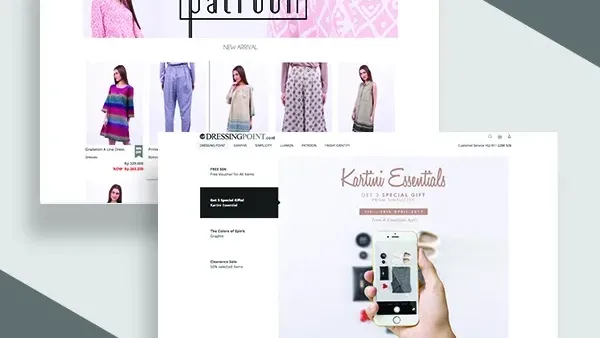

Creating one online destination for five distinct fashion identities
Dressing Point brings together five Indonesian apparel brands for dynamic and fashionable women: Simplicity, Graphis, Llaneza, Patroon, and Friday Identity. Each brand had its own character, but they shared a broader ambition—to expand the reach of Indonesian fashion and make their products easier to discover.
That ambition emerged as shopping behavior shifted from visiting physical stores to browsing products online. Customers increasingly researched styles, compared options, and decided what to buy through digital channels before speaking with a sales associate or entering a store.
Suitmedia partnered with Dressing Point to create its first e-commerce website. The goal was to bring the confidence, variety, and visual appeal of an offline fashion store into a single online experience that worked across desktop and mobile devices.
Five brands needed one store without losing their individual identities
1. Offline retail habits were moving online
The five brands had traditionally depended on physical retail experiences. Customers could visit a store, view the clothing, ask questions, and make a purchase with assistance from sales staff.
Online shopping changed that sequence. Customers could now discover products independently, compare styles, and decide whether to purchase without visiting a physical location.
This shift created both pressure and opportunity. Without a digital channel, the brands risked losing customers earlier in the shopping journey. With the right platform, they could reach customers beyond the locations of their stores and remain present when people were browsing from home or on mobile devices.
2. An online store could not simply replicate a product list
The challenge was not just to upload five product catalogs. Fashion customers respond to visual presentation, brand atmosphere, styling, and confidence in what they see.
A basic catalog might show products, but it would not necessarily recreate the sense of browsing a fashion store. Customers needed to understand the differences between the brands, explore products easily, and feel inspired enough to continue toward purchase.
The website therefore needed to function as a retail experience, not merely an inventory database.
3. The brands had to share a platform without becoming indistinguishable
Each Dressing Point brand had its own identity. A single website risked making them feel too similar if the design was completely standardized.
At the same time, five unrelated visual systems could make the platform feel fragmented and difficult to navigate. The challenge was to create a common structure that allowed each brand to remain recognizable.
This required a careful balance between unity and distinction. Customers needed to understand that the brands belonged to one broader retail destination while still seeing the unique character of each label.
4. Fashion decisions depend heavily on visual confidence
Customers often judge fashion products through images before reading detailed information. The way clothing is photographed, positioned, and presented influences whether a visitor feels interested enough to explore further.
If product imagery is weak or the layout is cluttered, the website can make the products appear less appealing than they are. This is particularly damaging when customers cannot touch the fabric, inspect the fit, or see the item in person.
The platform needed to compensate for the absence of physical contact through strong photography, clear product information, and a visual environment that made the products feel desirable.
5. The path from discovery to purchase had to be short
Fashion customers may browse several products before deciding what they want. Every additional point of confusion can interrupt that process.
The website needed to make it easy to choose clothing, understand product details, select the next action, and move toward conversion. Customers should not have to search for the purchase button or navigate through unrelated pages to complete a transaction.
A shorter, clearer path would help preserve the momentum created by strong product presentation.
6. The online experience needed to support the wider retail model
Dressing Point wanted to bring elements of the offline store into the online environment. Customers needed more than an online payment option; they needed flexibility around value, loyalty, and fulfillment.
Gift cards, vouchers, member points, and the ability to pick up products in-store could help connect the digital and physical experiences.
These features were important because customers do not all shop in the same way. Some may prefer delivery, others may want to collect an item in person, and loyal customers may expect recognition through points or offers.
7. Mobile access was central to the customer journey
Customers increasingly used mobile phones to browse fashion products. A website that worked well only on a large screen would exclude users at the moment they were most likely to discover new styles.
Mobile design therefore had to be treated as a primary experience rather than a smaller version of the desktop site.
Product images, descriptions, menus, and purchase actions all needed to remain clear and usable on smaller screens. If mobile browsing was difficult, the brands could lose customers before they reached the consideration stage.
Designing a shared fashion experience with room for individuality
1. Begin with the role of the platform
Suitmedia approached Dressing Point as a shared e-commerce destination for five brands, not simply a collection of separate websites.
The platform needed to make cross-brand discovery possible while allowing customers to enter through the brand or product most relevant to them. This gave Dressing Point a broader reach without requiring customers to understand the structure behind the business.
A shared platform also created operational value. Product presentation, shopping functions, loyalty features, and checkout could be supported through one common environment.
2. Use minimal design to make the products lead
The website used a minimal layout with large images as the primary focal point.
This was a strategic choice. Fashion products should receive the attention, while the interface provides enough structure to help customers browse and act.
Minimal design reduced visual competition and created space around the product imagery. It allowed the clothing to communicate style and quality before the customer moved into detailed information.
The result was a digital environment that felt closer to a curated fashion store than a crowded online marketplace.
3. Use photography to create desire and context
Large, prominent photographs helped customers understand the look and feel of the products.
Photography is particularly important in fashion because customers want to imagine how an item appears when worn, how it fits within a collection, and whether it reflects their personal style.
Strong imagery also supported the five brands’ identities. Each label could present its products in a way that reinforced its own mood while still fitting within the wider Dressing Point experience.
4. Give each brand a recognizable visual expression
The design allowed the five brands to use different colors, visual treatments, and tones.
This helped protect the distinctiveness of Simplicity, Graphis, Llaneza, Patroon, and Friday Identity. Customers could move between brands without feeling that every label had been reduced to the same visual language.
The shared platform provided consistency in navigation and functionality, while the individual brand treatments provided differentiation. This made the relationship between the brands understandable without making them interchangeable.
5. Keep the underlying shopping structure consistent
Although the brands had distinct visual identities, the core shopping journey needed to remain familiar.
Customers should not have to relearn how to browse, view details, or purchase every time they moved from one brand to another. Consistent interaction patterns reduced friction and made the multi-brand experience easier to use.
This was a crucial design principle. Brand differentiation belonged primarily in expression and content, while the basic mechanics of shopping remained stable.
6. Make product details easy to explore
Product information was presented alongside clear calls to action.
This helped customers move from visual interest to practical evaluation. They could understand the item, decide whether it suited their needs, and continue toward purchase without losing their place.
The close relationship between product information and action was intentional. Customers should not need to browse through several layers of content before they could make a decision.
7. Create a simple path to conversion
Suitmedia designed the website around a straightforward journey for choosing clothes and completing a purchase.
The platform avoided unnecessary complexity between product discovery, selection, and checkout. This reduced the chance that customers would abandon the process because they were unsure what to do next.
A simple conversion path also supported the sales role of the website. It allowed the digital store to do more than create awareness; it could help turn interest into measurable commercial action.
8. Add gift cards and vouchers to extend value
Gift cards and vouchers were included as part of the e-commerce experience.
These features gave customers more ways to interact with the brands and created opportunities for purchases beyond individual self-selection. A gift card can introduce a brand to a new customer, while a voucher can encourage a return visit or make a purchase feel more valuable.
The features also helped translate familiar offline retail practices into the online environment.
9. Use member points to support loyalty
Member points connected the digital shopping experience with ongoing customer recognition.
Loyalty points can encourage customers to return, especially when the benefit is clear and connected to future purchases. They also give the brands a way to recognize repeated engagement rather than treating every transaction as separate.
This supported the broader objective of growing the audiences of all five brands. A customer could begin with one product or label and remain connected to the wider Dressing Point ecosystem.
10. Connect online purchase with store pickup
The option to pick up products at a store helped bridge digital and physical retail.
Customers could browse and make decisions online while retaining the convenience or familiarity of collecting their purchases in person. This also gave the physical stores a continued role in the customer journey.
The feature recognized that omnichannel retail is not about forcing customers into one channel. It is about giving them flexibility while keeping the experience connected.
11. Design for mobile browsing first
The website was fully responsive and mobile-friendly.
Product images, descriptions, navigation, and calls to action were adapted to smaller screens so customers could browse comfortably on their phones.
This protected the quality of the experience across devices. A customer who discovered a product through a mobile link should be able to continue exploring and purchasing without needing to move to a desktop computer.
Mobile responsiveness also supported the brands’ reach. Customers could encounter Dressing Point wherever they were, not only when sitting in front of a larger screen.
12. Keep calls to action visible beside the product
The design placed product information and purchase actions close together.
This reduced the effort required to act on interest. Customers did not need to remember a product, search for it again, or navigate away from the detail page to find the next step.
Visibility was particularly important on mobile devices, where limited screen space can easily hide important actions. The interface needed to balance detail with a clear route toward conversion.
13. Use a shared platform to improve operational efficiency
A multi-brand e-commerce site allowed Dressing Point to manage several labels through one digital foundation.
This could make future updates, platform improvements, and customer experience enhancements more efficient. The brands could benefit from shared commerce capabilities while continuing to express their own identities.
The shared structure also supported learning. Customer behavior across brands could help inform future decisions about content, product presentation, and loyalty.
14. Build the experience around fashion confidence
The site was designed to help customers feel confident while browsing and choosing products.
Clear imagery reduced uncertainty about appearance. Organized product information supported evaluation. Simple navigation reduced effort. Loyalty and fulfillment options provided flexibility.
Together, these choices recreated important parts of the offline experience in digital form. The customer could explore, compare, decide, and purchase with less dependence on a physical sales associate.
A multi-brand digital store expanded reach while preserving identity
1. Dressing Point gained its first unified e-commerce platform
The new website gave the five brands a shared digital destination where customers could browse and purchase apparel.
This strengthened their online presence and allowed them to reach customers who preferred digital shopping. The brands could now participate in the discovery process before customers visited a physical store—or instead of visiting one.
The platform also gave Dressing Point a clearer identity as a combined fashion destination.
2. The five brands remained distinct within one experience
The visual system allowed each brand to maintain its own look and feel while operating within a consistent platform.
This preserved brand equity. Customers could recognize the difference between the labels while understanding that they were part of a connected retail group.
The result was more effective than either extreme: five disconnected websites would have weakened shared discovery, while one uniform identity would have reduced the value of the individual brands.
3. Product presentation became more compelling online
Large images, minimal layouts, and clear product details created a stronger digital presentation for the clothing.
This helped the website compensate for the lack of physical contact. Customers could browse products in a visual environment designed to communicate style and appeal.
The improved presentation also gave the brands a more polished digital image. A strong website can influence not only what customers buy, but how they perceive the maturity and credibility of the brand.
4. Customers received a more convenient path to purchase
The e-commerce journey made it easier for users to browse, select, and move toward conversion.
The addition of gift cards, vouchers, member points, and store pickup gave customers greater flexibility in how they interacted with the brands.
These features strengthened convenience while preserving connections to the physical retail environment. Customers could choose the path that best matched their preferences.
5. Mobile users gained equal access to the experience
The responsive website maintained the quality of the experience across screen sizes.
This increased the chances that customers could discover, evaluate, and purchase products through the device they used most often.
The impact extended beyond technical accessibility. A strong mobile experience helped the brands remain present in the fast-moving moments when customers browse fashion content and decide what to explore.
6. The brands created more opportunities for repeat engagement
Member points, vouchers, new collections, and a multi-brand catalog gave customers reasons to return.
A customer who discovered one label could potentially explore the others. A customer who completed one purchase could remain connected through loyalty benefits and new product updates.
This created a broader relationship than a single transaction. Dressing Point could build a customer base across several brands while allowing each label to maintain its own appeal.
7. The platform connected digital discovery with physical retail
Store pickup helped link online shopping with the existing retail network.
This created a more flexible customer journey and allowed the brands to benefit from both digital convenience and physical presence.
The platform therefore supported an omnichannel model before the term became common in everyday retail strategy. Customers could move between online and offline touchpoints according to what suited them.
8. Dressing Point gained a foundation for continued digital growth
The website created a base for future e-commerce improvements, content development, loyalty enhancements, and customer insight.
The brands could build on a working platform rather than treating the first launch as the end of the digital journey.
The second-order effect was greater strategic flexibility. Dressing Point had a foundation from which it could respond to changing fashion behavior, mobile usage, and customer expectations.
The deeper lesson: multi-brand commerce must simplify choice without flattening difference
1. A shared platform should create scale for the business and clarity for the customer
Combining five brands can improve reach and efficiency, but only if customers understand how to navigate the relationship between them.
The platform used shared commerce functions and consistent interaction patterns to reduce confusion. This allowed Dressing Point to gain scale without making the customer experience feel fragmented.
2. Brand distinction should live within a consistent customer journey
Customers should be able to recognize that brands are different, but they should not have to relearn how to shop each time they switch labels.
The project separated expression from operation. Brand identity could vary through color, imagery, and tone, while core shopping behavior remained familiar.
3. Fashion e-commerce depends on confidence, not only convenience
A fast checkout is useful, but customers also need confidence in what they are choosing. Strong photography, clear details, and an uncluttered layout help replace some of the reassurance provided by a physical store.
The digital experience must therefore answer both questions: “Can I buy this easily?” and “Can I feel confident buying it?”
4. Loyalty features can connect brands into a broader ecosystem
Member points, vouchers, and gift cards create opportunities for customers to move between brands and return to the platform.
These features should not be treated as isolated promotions. They can help build a broader relationship across a group of brands while still allowing each label to remain distinct.
5. Mobile design is essential to modern fashion discovery
Customers often encounter fashion products through mobile devices, links, social content, and quick browsing sessions.
A mobile-friendly experience ensures that interest is not lost because the platform is difficult to use on a smaller screen. Mobile is not a secondary channel; it is a central part of the discovery journey.
6. Omnichannel value comes from flexibility
Store pickup showed that online and offline retail do not have to compete. Customers should be able to choose how they browse, buy, and receive products.
The strongest retail platforms preserve continuity across these choices. They allow the customer to move between channels without feeling that the relationship has been reset.
Strategic Insights for the C-Suite
- Use shared platforms to create scale without erasing brand difference. Common commerce infrastructure can improve efficiency, but customers still need to understand what makes each brand distinct. Separate identity from the underlying shopping mechanics.
- Design fashion e-commerce to build confidence as well as convenience. Strong imagery, useful product details, and clear calls to action help customers make decisions when they cannot touch or try on the product.
- Treat mobile as a primary retail environment. Customers often discover and evaluate fashion through their phones. A poor mobile experience can interrupt the journey before consideration becomes purchase.
- Connect loyalty features to the wider brand ecosystem. Points, vouchers, and gift cards can encourage repeat use and cross-brand discovery when they are designed as part of one relationship rather than isolated promotions.
- Give customers freedom to move between online and offline channels. Store pickup and connected experiences reduce the trade-off between digital convenience and physical reassurance. Omnichannel retail should follow customer preference, not force a single path.