
How Persona Design Turned AI Into a Brand Relationship Engine
The Paradox of Scale Without Connection
Toyota Astra Motor had achieved something most automotive leaders dream of: a growing customer base that kept expanding. But growth created a new problem that traditional customer service couldn't solve. As the customer roster multiplied, the brand-consumer relationship began to thin.
The company faced a fundamental tension: how to serve more customers with more personalization, not less. Phone lines were overwhelmed. Email responses took days. Dealership visits required appointments and travel time. Traditional channels were becoming bottlenecks instead of bridges.
Toyota understood the trend: artificial intelligence chatbots were emerging as the answer. But the company also understood the risk: a chatbot that sounded like a machine would deepen the distance between brand and customer, not close it. They needed something that felt human, conversational, and trustworthy—not a FAQ engine that deflected problems.
The challenge wasn't technology. It was psychology: how do you make a customer believe they're talking to a friend, not a script?
Why Standard AI Chatbots Fail at Relationship Building
By 2018, chatbots were everywhere. But most of them were forgettable. They worked because they answered basic questions. They failed because they didn't make customers feel anything.
Most automotive brands approached chatbots as a cost-reduction play. Fewer support calls meant lower headcount. The chatbot was designed to be efficient, not engaging. Questions got answered in 2-3 exchanges, and if the customer needed more, the bot would route them to a human with a sense of failure—as if the machine couldn't handle the real work.
1. The Efficiency Trap
Toyota realized that pure efficiency was the wrong metric. A chatbot that answered a question in 30 seconds but left the customer feeling dismissed was actually more expensive than a human interaction that took 5 minutes but built loyalty.
The real cost wasn't the conversation time. It was the customer sentiment cost. A customer who felt like they were talking to a machine would never come back. They'd post negative reviews. They'd tell friends. The chatbot would become a brand liability, not an asset.
2. The Personalization Paradox
Here's what most companies got wrong: they thought personalization meant knowing a customer's purchase history or name. But real personalization is deeper. It's understanding who the customer is as a person—their values, their communication style, their emotional triggers, what they care about.
A standard chatbot couldn't do this. It was trained on generic automotive knowledge. It had no personality. It couldn't adapt its tone based on who it was talking to. It would give the same answer to a first-time buyer and a loyal customer who'd owned three Toyotas.
3. The Trust Gap
Finally, there was the trust problem. Customers knew they were talking to a machine. That knowledge shaped every interaction. They wouldn't ask real questions because they assumed the machine couldn't handle nuance. They wouldn't come back because there was no relationship to maintain.
Toyota needed to close this gap—not by hiding the fact that the chatbot was a machine, but by giving it enough personality and competence that customers would forget to care.
The Architecture of Authentic AI Chatbot Conversation
Suitmedia's approach was counterintuitive: the best AI chatbot isn't the smartest one. It's the one that sounds most like someone you'd want to talk to.
This meant starting not with technology, but with anthropology.
1. Consumer Research as the Foundation
Suitmedia began by abandoning the template approach. Instead of building a chatbot and hoping customers liked it, the team conducted deep consumer research across three segments: new customers, existing loyal customers, and prospects who hadn't bought yet.
The research questions were specific: What frustrates you when you need help with a Toyota? What information do you actually need, versus what we assume you need? How do you prefer to communicate—formally or casually? What tone makes you trust a brand?
The data painted a clear picture. Toyota customers weren't looking for an encyclopedia of automotive facts. They were looking for a caring assistant—someone who remembered that they owned a car, understood their lifestyle, and could give advice tailored to their situation, not a generic answer.
Existing customers wanted someone who treated them like family, not like a transaction. They wanted to feel special, not processed. New customers wanted reassurance and education without feeling pressured. Prospects wanted to explore without commitment.
2. AI Chatbot Persona as Strategy, Not Decoration
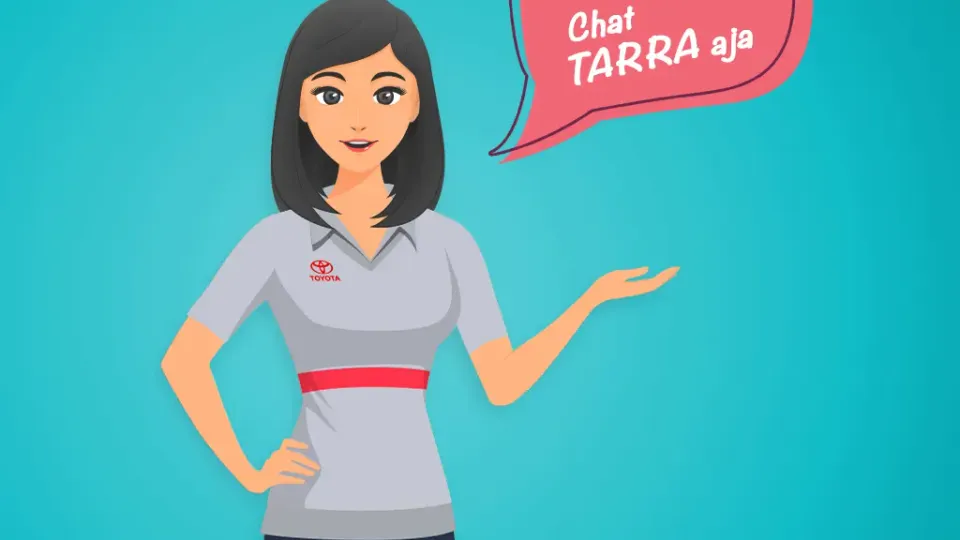
With the research in hand, Suitmedia created TARRA (Toyota Interactive Virtual Assistant)—but this wasn't just a name and avatar slapped onto a chatbot. TARRA was a strategic persona built from customer psychology.
The team made deliberate choices:
Female identity. Research showed that customers in the target demographic responded better to a female assistant. It created a sense of approachability and trustworthiness.
Active personality with a boyish edge. This wasn't corporate femininity. TARRA had energy, humor, and a bit of irreverence. She could talk about cars in a way that felt knowledgeable without being condescending.
Warm, friendly, polite language. This was the critical balance. TARRA was professional enough to be credible, but casual enough to be human. She didn't use corporate jargon. She talked the way a knowledgeable friend would talk.
The persona wasn't random. Every element was tied to customer data. Every choice was designed to answer a specific question: Would I trust this person with my car question?
3. Conversation Design as Craft
The next layer was conversation design—the actual words TARRA would use in different scenarios. This was where most companies cut corners. They'd write a chatbot script in an afternoon and launch it.
Suitmedia built conversation flows like a screenwriter builds dialogue. The team considered:
- Tone consistency. TARRA would sound the same whether answering a basic question or handling a frustrated customer.
- Contextual adaptation. The conversation would shift based on who was asking. A first-time buyer would get education; a loyal customer would get acknowledgment of their loyalty.
- Emotional intelligence. If a customer expressed frustration, TARRA would acknowledge it, not just solve it.
- Natural flow. The conversation would feel like a text exchange with a friend, not a support ticket being processed.
4. AI Chatbot Utility as the Bridge to Engagement
But personality alone wouldn't sustain engagement. Customers would only come back if TARRA actually solved their problems. So the team mapped out core use cases:
- Product discovery (helping customers find the right car based on lifestyle)
- Purchase support (guiding customers through the buying process)
- Service bookings (making it frictionless to schedule maintenance)
- Product education (sharing maintenance tips and product features)
- Promotional updates (alerting customers to new offers in a personalized way)
Each function was designed to be useful and conversational. When TARRA recommended a car model, she'd explain why based on the customer's stated lifestyle, not just list specs. When she booked a service, she'd confirm the appointment, but also ask how the car was performing. She was helpful first, supportive second.
5. Always-On Availability as Psychological Comfort
Finally, the team made a strategic choice: TARRA would be available 24/7. This wasn't just convenience. It was psychological.
In the automotive journey, questions emerge at odd hours. A customer might be thinking about purchasing at 11 PM on a Sunday. They might wonder if their car is making a normal noise at 2 AM on a Tuesday. With a human customer service team, they'd have to wait. With TARRA, they could get an answer immediately.
This created a subtle but powerful effect: the customer felt like Toyota was always there for them. The brand wasn't a dealership you visited during business hours. It was a relationship you could tap into anytime you needed support.
The Outcomes: From Engagement Metrics to Relationship Data
By the end of 2019, TARRA had fundamentally changed how Toyota interacted with its customer base. The metrics told part of the story, but the real story was what those metrics represented.
1. Engagement That Actually Predicted Behavior
TARRA was reaching customers on LINE and Facebook Messenger—channels where they were already hanging out. This wasn't interrupting customers' lives; it was showing up where they already were.
The engagement numbers grew consistently. Customers weren't just asking one question and leaving. They were coming back repeatedly. Some customers had ongoing conversations with TARRA spanning weeks, asking follow-up questions, sharing updates about their vehicles, seeking advice on maintenance.
The engagement wasn't vanity metrics. High engagement on a chatbot predicted high engagement with the brand. Customers who interacted with TARRA multiple times showed higher purchase intent, higher service appointment booking rates, and higher net promoter scores.
2. The Data Bridge: From Questions to Insights
Every conversation TARRA had was market research in real time. The team could see exactly what customers wanted to know—not what Toyota assumed they wanted to know, but what they actually asked about.
Patterns emerged. Certain car models generated more questions in specific regions. Certain maintenance topics came up repeatedly. Certain customer segments had specific concerns. This wasn't demographic data from surveys. This was behavioral data from real conversations.
Toyota used this intelligence to adjust product communication, service offerings, and even dealership training. If TARRA was getting hundreds of questions about fuel efficiency for a specific model, that meant the marketing materials weren't communicating that benefit clearly. If customers were asking about warranty details, Toyota could streamline the warranty documentation.
The AI chatbot became a real-time market research engine.
3. The Relationship Deepening
The most important outcome was invisible in most metrics. Customers began to develop a relationship with TARRA. They came back not just because they had a problem, but because they trusted her.
Loyal customers would check in on promotions. They'd ask for advice on accessories. They'd recommend TARRA to friends. Some customers even thanked TARRA by name in their messages—evidence that they'd crossed the threshold from "talking to a chatbot" to "talking to a virtual assistant I like."
This was the goal that most automotive brands never achieve: turning a customer service tool into a relationship asset. TARRA wasn't reducing customer support costs by deflecting inquiries. She was building customer loyalty by being consistently helpful, warm, and knowledgeable.
4. The Operational Multiplier
On the operations side, TARRA handled high-volume, routine inquiries that would have required dozens of customer service staff. But she did it in a way that actually improved customer sentiment, not degraded it.
The dealership teams loved TARRA because she was pre-qualifying customers and answering basic questions before they arrived. A customer who'd already had a conversation with TARRA about their needs would come to the dealership ready to make a decision, not ready to ask basic questions. Sales cycles compressed. Close rates improved.
Service teams loved TARRA because customers were already familiar with the Toyota brand voice and service approach. They weren't cold-calling a dealership; they were continuing a conversation they'd already started.
5. The Scalability Story
The most durable outcome: Toyota had built a relationship infrastructure that scaled. As the customer base grew, TARRA could handle the growth without diluting the customer experience.
In fact, the opposite happened. As TARRA got more conversations, her responses got better. The team could see which conversation flows worked and which ones confused customers. They could identify new use cases emerging from real conversations. Each month, TARRA became a better version of herself.
This created a feedback loop where scale actually improved quality—the opposite of what happens with human customer service teams. More customers meant more data, which meant better responses, which meant higher satisfaction, which meant more customers.
Three Principles About Building Trust Through AI Chatbot Technology
1. Authenticity Beats Efficiency in the Long Game
The instinct is to optimize a chatbot for speed: answer quickly, resolve, move to the next customer. But customers don't come back to services that are fast and cold. They come back to services that feel like they care.
TARRA was deliberately designed to take more time if it meant the customer felt understood. A conversation that took five exchanges but made the customer feel like TARRA knew their situation was more valuable than a conversation that got answered in two exchanges but felt generic.
This principle extends beyond chatbots. Any customer interaction optimized purely for efficiency will eventually lose to a competitor who optimizes for authenticity. The fast path is easy to copy. The authentic path requires deep customer understanding and is nearly impossible to replicate.
2. Personality Is Not Optional—It's Structural
Many companies treat persona as decoration: a nice-to-have brand element. Toyota treated it as structural. TARRA's personality wasn't added after the chatbot was built. It was the foundation for how conversations were designed.
This meant that every response TARRA gave had to pass a personality filter: "Would TARRA say this in this way?" If the answer was no, the response got rewritten. This discipline ensured that the chatbot didn't slip into corporate-speak or robotic patterns.
The insight: consistency of personality builds trust faster than consistency of information. Customers will forgive a chatbot for not knowing something. They won't forgive it for being inconsistent about who it is.
3. Always-On Availability Changes the Relationship Equation
By being available 24/7, TARRA fundamentally changed the customer's relationship with Toyota. She wasn't a service desk you visited during business hours. She was a friend who was always there.
This created a psychological shift. Customers began to think of Toyota not as a company they bought a product from, but as a brand they had an ongoing relationship with. Questions that used to wait weeks for an answer got asked immediately and resolved immediately. Concerns that used to linger until the next dealership visit got addressed and resolved.
The result: customers felt more supported, more seen, more valued. And that feeling translated into loyalty, repeat purchases, and recommendations.
Strategic Insights for the C-Suite
1. Treat Your AI Chatbot as a Relationship Investment, Not a Cost Reduction
The temptation is to deploy a chatbot to cut customer service headcount. That's the wrong mental model. Deploy a chatbot to deepen relationships at scale. If it also reduces headcount, that's a bonus. But if it comes at the cost of customer sentiment, it's a net loss.
The math that matters: not cost-per-interaction, but lifetime value-per-customer. A chatbot that costs more per interaction but increases customer lifetime value by 20% is a massive win. A chatbot that cuts cost-per-interaction by 30% but reduces lifetime value by 10% is a massive loss. Most companies measure the wrong metric.
2. AI Chatbot Persona Design Requires Customer Research, Not Creative Intuition
The instinct is to design a chatbot persona based on brand guidelines or creative direction. That's backwards. Persona design should be driven by customer data: who are they, how do they communicate, what do they value, what tone makes them trust you?
Toyota's willingness to do extensive consumer research before creating TARRA was the difference between a generic chatbot and one that customers actually wanted to talk to. You can't intuit this. You have to listen to customers first, then design based on what you learn.
3. Conversation Design Is as Critical as Technical Capability
Most companies invest 80% of their budget in chatbot technology and 20% in conversation design. It should be the opposite. A technically sophisticated chatbot with poor conversation design will frustrate users. A technically simple chatbot with brilliant conversation design will delight them.
The team that designs how your chatbot talks to customers matters more than the team that builds the underlying AI. Invest accordingly.
4. Real-Time Behavioral Data Is More Valuable Than Traditional Market Research
Every conversation a chatbot has is market research in real time. What customers ask reveals what they care about. The frequency of questions reveals what's unclear in your marketing. The tone of follow-ups reveals satisfaction levels.
Use your chatbot as a sensing mechanism for your entire business—product, marketing, service, sales. Most companies miss this advantage because they treat the chatbot as isolated from the broader business. It should be the opposite: the chatbot is your most direct line to what customers actually want.
5. Scale Your Relationship Infrastructure, Not Just Your Transaction Capacity
The goal isn't to handle more customer service inquiries with fewer humans. The goal is to deepen relationships with more customers. Those are different challenges with different solutions.
A traditional support center scales by adding more staff or more automation. A relationship infrastructure scales by building systems that customers actually want to engage with repeatedly. TARRA didn't handle 10x more inquiries than a human support team would have. She built 10x deeper relationships with customers. That's a different—and far more valuable—outcome.