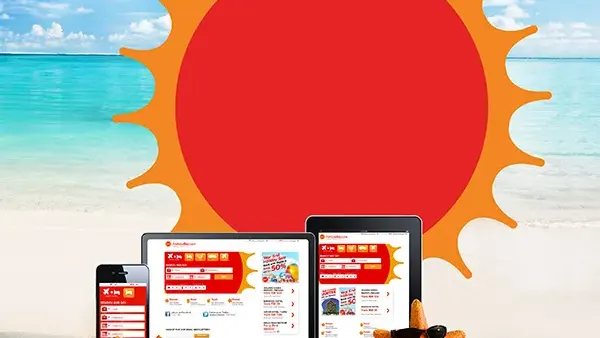

AirAsiaGo Indonesia (AAGO) was one of Asia’s fastest-growing online travel portals, offering hotels, activities, and travel options for different budgets and needs.
The commercial opportunity was clear. More travelers were researching and booking online, but growth in a crowded market required more than simply listing travel products. AAGO needed to become recognizable, useful, and socially relevant before customers were ready to book.
Between 2012 and 2015, Suitmedia helped AAGO build that presence through an integrated series of digital campaigns and offline activations. The work combined destination content, social media, contests, blogger relations, media engagement, and mall roadshows.
The strategic ambition was to position AAGO as more than a booking platform. It was to make the brand feel like a warm, practical travel advisor—one that helped people decide where to stay, eat, visit, and shop, while also giving them a direct path to book flights and hotels.
A Fast-Growing Travel Brand Needed More Than Product Visibility
1. Travel choices were becoming more digital and more crowded
AAGO offered a broad selection of hotels, activities, and travel products. But customers had many ways to discover and compare similar offers, from travel websites and search engines to social media and offline promotions.
This created a fundamental brand challenge. AAGO needed to remain visible in a category where customers might not think about booking until they had already formed an idea about where to go.
The brand therefore had to enter the customer’s decision process earlier. Instead of waiting for a traveler to search specifically for a hotel or package, AAGO needed to become part of the inspiration and planning stage.
That required communication with a clear role. Content could not simply announce discounts or products. It had to help travelers imagine destinations and make better choices.
2. Awareness needed to become engagement
Increasing brand awareness was an explicit priority, but awareness alone would not create a long-term position.
A customer may see a travel brand once and still forget it. Repeated interaction is more likely when the brand gives people useful, entertaining, or participatory reasons to return.
AAGO needed to create opportunities for people to respond to the brand—not only view an advertisement. That meant inviting users to explore destinations, submit photos, attend events, follow real-time updates, and share travel-related experiences.
The challenge was to make interaction feel natural rather than forced. Travel is already a social and visual category, so the campaigns needed to use those characteristics in a way that strengthened the brand.
3. The brand had to feel helpful before it asked people to buy
A booking platform naturally wants to promote flights, hotels, and packages. But customers do not always begin with a purchase decision. They may begin with a question:
Where should I go? What should I do there? Which destination fits my budget? Where can I find a memorable experience?
Suitmedia positioned AAGO as a travel advisor that could help answer those questions. This gave the brand a role beyond selling inventory.
The approach was important because advice creates a more durable relationship than promotion alone. When a brand helps customers plan, it becomes relevant even before a transaction is imminent.
4. Digital campaigns needed support from physical experiences
Social media could extend reach and create conversations, but travel is also experienced physically. AAGO needed to connect online communication with real-world interactions.
This led to a campaign portfolio that included microsites, social media activity, blogger gatherings, mall roadshows, media gatherings, and an offline challenge.
Each format served a different purpose. Digital content supported discovery and sharing. Events created direct contact. Bloggers and media helped provide third-party credibility. Roadshows brought the brand to potential customers in high-traffic locations.
The strategic question was not which channel was best in isolation. It was how each channel could reinforce the others.
Building a Travel Brand Through Content, Participation, and Reach
1. We defined AAGO as a helpful travel companion
The central positioning was to present AAGO as a warm travel advisor that regularly shared useful travel information.
This gave the brand a consistent role across campaigns. AAGO could talk about destinations, food, culture, shopping, hotels, and activities while still connecting those topics to its booking service.
The positioning also allowed the brand to communicate with different levels of customer intent. Someone who was only exploring destinations could engage with inspiration, while someone closer to purchase could discover a flight or hotel package.
The decision to lead with usefulness was deliberate. A brand that helps customers make decisions earns more opportunities to remain part of the conversation.
2. Telusur Nusantara made local discovery the starting point
The Telusur Nusantara campaign encouraged travelers to explore Indonesia’s cultural and geographic diversity.
Suitmedia developed a microsite featuring glimpses of destinations, local food, culture, and tourism experiences. The purpose was to create curiosity and encourage people to explore further.
The campaign did not begin with a product catalog. It began with the destination itself. This made the content more emotionally engaging and gave AAGO a natural role as an enabler of travel discovery.
The microsite generated 6.4 thousand visitors, 6.1 thousand unique visits, and 7.7 thousand pageviews. It also recorded 75% retweets and 13% mentions, showing that the campaign encouraged sharing and conversation around the content.
These signals mattered because they demonstrated movement beyond passive exposure. People were not only arriving at the microsite; they were helping extend its reach through social interaction.
3. The Facebook photo contest turned audiences into contributors
Suitmedia also developed a Facebook photo competition in which participants uploaded thematic travel photos and winners were selected based on the number of likes received.
The campaign used a simple behavior: people sharing visual experiences with their social networks. This fit the travel category naturally because destinations and personal memories are highly visual and easy to discuss socially.
The contest also gave participants a reason to distribute AAGO-related content through their own networks. Instead of the brand carrying the entire burden of communication, the campaign encouraged participants to become temporary promoters.
The activity reached 105 thousand fans, generated 1,905 new likes, produced 10 thousand pageviews, attracted 105 contestants, and received 218 photo uploads.
The value was not limited to the contest period. User-generated participation helped associate AAGO with travel inspiration and personal expression rather than only commercial offers.
4. The blogger meetup created trusted third-party voices
AAGO Travel Bloggers Meetup brought Indonesian travel bloggers together at Comma ID in Jakarta.
The event was designed to build relationships between AAGO, travel bloggers, and the brand’s audience. This was important because travel decisions are often influenced by personal accounts and recommendations.
A blogger can provide a different kind of credibility from a brand advertisement. Their perspective may help audiences understand how a travel service performs in real use and why a destination is worth considering.
The meetup therefore supported more than event attendance. It created conditions for continued coverage and relationship-building. Bloggers subsequently increased awareness of AAGO through articles about its services.
This was a long-term communication decision. Rather than treating creators as one-time media placements, the campaign focused on building relationships that could support future conversation.
5. Mall roadshows brought the digital proposition into physical spaces
AAGO also needed to reach customers who might not encounter the brand through online channels alone.
Suitmedia developed mall-to-mall roadshows in Jakarta, Bandung, Surabaya, and Bali. These activations created direct contact with potential customers in high-traffic environments.
The offline activities were supported by online campaigns, including quizzes and real-time social media posts. This connection allowed people at the event to participate digitally while also giving online audiences a way to follow what was happening.
The purpose was to connect attention with action. Offline interaction created immediacy and human contact, while social media extended the life and reach of each roadshow.
This combination also helped AAGO move closer to sales conversion. The brand could engage people in person while using digital channels to continue the conversation after the event.
6. Media gatherings supported launch credibility
Suitmedia organized a media gathering to strengthen relationships with media outlets and support the launch of the new AirAsiaGo and Telusur Nusantara website.
Personal relationships mattered because media coverage could help explain the platform and campaign to a broader audience.
The gathering created space for media representatives to understand the brand, the service, and the purpose behind the campaign. This was more effective than relying only on a press announcement because it supported direct communication and relationship-building.
The activity also reinforced the wider campaign system. Content, events, social media, and public relations worked together to create multiple forms of attention around AAGO.
7. The Make a Room, Please! challenge used surprise to create attention
The Make a Room, Please! campaign brought the travel theme into an unusual offline format. A bedroom set, including a super king-size bed, was placed in a car and used as the basis for a public challenge.
The idea was designed to create surprise and invite participation. It gave people a physical experience they could see, discuss, and share through social media.
This kind of activation works when the audience can understand the idea quickly and has a reason to talk about it afterward. The campaign connected an everyday object associated with travel accommodation to a memorable public experience.
The activity helped increase AAGO’s visibility among potential new customers and added a distinct human element to the wider campaign program.
8. We connected campaigns across channels rather than treating them as isolated events
The individual campaigns had different formats, but they shared a common role for AAGO.
The microsite provided destination inspiration. Social media extended participation and conversation. Blogger activity created third-party stories. Roadshows created direct contact. Media gatherings supported credibility. The offline room challenge created memorable attention.
This integration mattered because travel brands compete for repeated recognition. A customer might first encounter AAGO through a destination story, later see a photo contest, and eventually engage with a booking offer.
Each interaction reinforced the others. The brand became more familiar through repeated exposure across different contexts, while the underlying travel-advisor positioning remained consistent.
From Booking Platform to Recognizable Travel Companion
1. AAGO expanded its presence beyond direct selling
The campaign program helped AAGO communicate as a travel brand rather than only as a transaction platform.
Destination content and travel discussions gave the company a broader relationship with its audience. The brand could be useful during inspiration, planning, and booking.
This increased the number of moments in which AAGO could enter the customer journey. A traveler did not need to be ready to purchase in order to find the brand relevant.
2. Social participation increased the brand’s reach
Across the campaigns, AAGO created several ways for audiences to contribute, share, and interact.
The Facebook photo contest generated 105 thousand fans reached, 1,905 new likes, 10 thousand pageviews, 105 contestants, and 218 photo uploads. Telusur Nusantara generated 6.4 thousand visitors, 6.1 thousand unique visits, and 7.7 thousand pageviews, supported by significant retweeting and mentions.
These results show that the campaigns generated measurable attention and participation. They also demonstrate the value of designing content that audiences can pass along rather than content that only the brand publishes.
3. The brand’s social community grew across platforms
After the campaign and activation program, AAGO’s Facebook audience increased by 171 thousand fans. Its Twitter account gained more than 12 thousand followers, while Instagram gained 3 thousand followers.
These figures indicate that the brand built a broader social base across multiple platforms.
The importance of this growth was not only the size of the audience. A larger, more engaged community gave AAGO a stronger foundation for future travel content, offers, launches, and conversations.
4. Offline experiences gave the digital brand more human presence
The roadshows, blogger meetup, media gathering, and room challenge created direct experiences around AAGO.
This helped the brand feel more tangible. Customers and influencers could encounter the company through real interactions rather than only through screens.
The second-order effect was stronger content potential. Offline events generated stories, photos, conversations, and relationships that could continue through digital channels.
5. The campaign system created a foundation for ongoing engagement
The most important outcome was the creation of a repeatable communication model.
AAGO could continue using destination content to build interest, social activity to encourage participation, influencers and media to extend credibility, and offers to support conversion.
This model was more durable than a single promotion because it gave the brand multiple ways to remain relevant throughout the travel decision process.
What AAGO Reveals About Building a Travel Brand in Social Channels
1. Awareness grows faster when people have a role to play
Audiences are more likely to remember a brand when they can contribute, share, attend, or respond.
The photo contest, roadshows, and room challenge transformed communication from a one-way message into participation. This increased the number of interactions associated with the brand and created content that could travel beyond the original campaign.
2. Useful content earns attention before purchase intent exists
Travelers often need inspiration before they need a booking platform.
By sharing destinations, culture, food, and travel ideas, AAGO could become relevant earlier in the customer journey. This is especially valuable in categories where decisions are planned over time rather than made immediately.
3. Integrated campaigns are stronger than isolated tactics
Each AAGO activity had a specific role, but the campaigns became more effective because they reinforced one another.
A microsite gave social activity somewhere to lead. Events created material for real-time posting. Bloggers and media extended reach. Offers connected attention to commercial action.
The lesson is to design the system before choosing individual tactics.
4. Third-party relationships can deepen credibility
Travel bloggers and media outlets helped AAGO communicate through voices audiences might find more independent and relatable than brand advertising.
These relationships require investment and trust. Their value comes from sustained credibility, not only short-term reach.
5. Community growth creates future marketing capacity
A growing social audience is not the final outcome. It is an owned base of potential future participants, customers, and advocates.
The strategic value increases when the brand continues to provide relevant content and meaningful interaction after the campaign ends.
Strategic Insights for the C-Suite
- Enter the customer journey before the purchase decision.
In travel and other considered categories, customers need inspiration before they need an offer. Build a role for the brand during discovery, planning, comparison, and purchase. - Design campaigns that let audiences participate.
Contests, events, and user-generated content create stronger memory than one-way promotion because people invest their own attention and identity in the experience. - Connect every channel to a shared business role.
Microsites, social media, influencers, media relations, and offline activations work best when each supports the same customer journey. Integration matters more than the number of channels used. - Treat community growth as long-term capacity.
A larger social audience creates future reach, but only if the brand continues to earn attention. Build communities around useful content and consistent interaction, not campaign volume alone.