The State Bank That Needed to Think Like a Startup
Bank Rakyat Indonesia (BRI) is one of Indonesia's largest commercial banks and a state-owned enterprise with millions of credit cardholders scattered across the archipelago. By 2012, BRI had a fundamental problem: the way it communicated with cardholders hadn't fundamentally changed in decades.
Promotions arrived via postal mail, email, or—if cardholders were lucky—SMS. Information about discounts, merchant partnerships, and exclusive offers was slow to distribute and easy to miss. Cardholders had no unified place to discover what privileges their card actually unlocked.
The result: vast promotional investments reaching cardholders weeks late, buried in inboxes, or not reaching them at all. Offers designed to drive spending sat dormant because the communication channel was fundamentally broken.
The Communication Gap: Why Traditional Channels Were Becoming Obsolete
By 2012, Indonesia's smartphone penetration was climbing rapidly. BlackBerry dominated the professional and upper-middle-class segments—precisely BRI's core credit card demographic. These were exactly the customers who could benefit most from real-time offer discovery.
Yet BRI's promotional machine still operated on postal and email timelines. A hot merchant promotion that could have driven immediate spending behavior was distributed via channels with days of latency.
1. The Institutional Inertia Problem
Large banks operate through entrenched communication infrastructure. Marketing departments create campaigns. Operations teams distribute them through established channels. IT systems are built around batch processes—send all emails at 2 AM, print all postcards on Tuesday.
This infrastructure worked fine when the competitive advantage was having a credit card. By 2012, the competitive advantage was knowing what your credit card could do for you, in real-time, when you needed it.
2. What Cardholders Actually Needed
BRI's cardholders didn't want more promotional noise. They wanted:
- Relevance: Not every offer applies to every cardholder. A restaurant discount helps if you eat out; a gas station offer helps if you drive.
- Immediacy: Learning about a weekend promotion on Friday is useful. Learning about it Monday is not.
- Discoverability: A centralized place to browse available offers, rather than hunting through emails and paper statements.
- Control: The ability to opt into categories they cared about, not passive receipt of everything BRI decided to send.
Traditional communication channels couldn't deliver any of these. Email was push-only and batch-based. SMS was expensive and limited to 160 characters. Direct mail was slow and wasteful.
A mobile app could solve all of them at once—if designed with user behavior in mind rather than internal process convenience.
The Strategic Choice: Mobile-First as Institutional Transformation
Suitmedia's approach began with a fundamental strategic insight: this wasn't a technology project; it was a business model project.
BRI needed to shift from "broadcast promotional messages to all cardholders" to "enable cardholders to pull offers they actually care about." This required not just building an app, but rethinking how BRI's marketing, operations, and technology teams worked together.
1. Why BlackBerry Was the Right Platform Choice
BlackBerry's dominance in Indonesia's professional segments in 2012 wasn't accidental. BRI's core credit card users—executives, entrepreneurs, business professionals—carried BlackBerrys the way they carried business cards. The platform had instant credibility and existing user behavior patterns (always-on, push notifications, integrated messaging).
Choosing BlackBerry first meant BRI could reach the highest-value cardholders immediately, build usage patterns, and learn what worked before fragmenting across Android and iOS. This wasn't following a trend; it was meeting users where they already were.
2. The Design Philosophy: Simplicity as Competitive Advantage
The user interface was deliberately stripped to essentials. Browsing promotions. Filtering by category. Saving favorites. Checking merchant locations. That's it.
This simplicity required enormous discipline. Every feature added was one more decision a cardholder had to make. Every design flourish was visual noise competing for attention.
The result was an app that did one thing exceptionally well: help cardholders discover and act on offers that mattered to them. Not gamification, not social features, not "engagement metrics"—just pure utility.
3. Visual Identity as Trust Signal
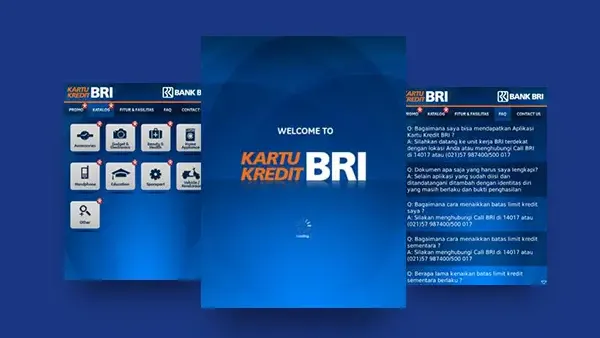
The design carefully maintained BRI's corporate identity rather than adopting trendy, app-store aesthetics. This wasn't about "looking corporate"—it was about maintaining the institutional trust that BRI had built over decades.
When a cardholder opened BRI Mobile Promo, they saw BRI's colors, BRI's typography, and BRI's visual language. The app felt like an extension of their banking relationship, not a startup experiment.
How the App Actually Worked: Form Follows Function
The user journey was obsessively optimized for the constraint of mobile screens in 2012: small displays, slow networks, limited processing power.
1. The Offer Discovery Loop
A cardholder opened the app and immediately saw available promotions—no login required for browsing, though redemption required authentication. Offers appeared as clean cards with essential information: merchant, discount, validity period, how to redeem.
Cardholders could browse by category (restaurants, shopping, travel, entertainment, fuel) or view a personalized feed based on previous searches and redemptions. The personalization logic was simple: show more of what users engaged with, less of what they ignored.
2. Reducing Friction at Decision Points
Every screen asked: "What does the cardholder need to decide next, and what information do they need to decide it?"
- Considering a restaurant offer? Show the discount clearly, the merchant name, the nearest location, and the redemption requirement.
- Need to check if the promo applies today? Validity dates were prominent, never buried in fine print.
- Want to know more? A single tap showed full terms, merchant details, and contact information.
The app eliminated the cognitive load of reading dense promotional fine print on a 3-inch screen.
3. Real-Time Updates as Operational Advantage
Because the app pulled offers from a live backend system rather than being preprogrammed with static content, BRI could update promotions in real-time. A merchant partnership could launch within hours. A successful promotion could be refreshed while it was still driving behavior.
This wasn't just convenience—it was a fundamental change in how BRI's marketing and operations teams could coordinate. Campaigns no longer required weeks of planning. Tactical opportunities could be seized immediately.
What Changed: The Behavioral Transformation
The app's impact unfolded in shifts in how cardholders interacted with BRI and how BRI engaged with them.
1. Cardholders Became Active Participants, Not Passive Recipients
Before: BRI sent promotions; cardholders received them (or didn't). Engagement was invisible to the institution.
After: Cardholders actively browsed available offers, filtered by their interests, and saved favorites. BRI could see exactly which offers generated interest and which didn't. A promotion that received zero app interactions was immediately visible as a failure.
This created a feedback loop: bad offers got corrected faster; successful offers got scaled immediately. The institution's marketing machine became dramatically more responsive.
2. Redemption Behavior Became Visible and Measurable
Traditional promotions disappeared into black boxes. Did customers actually use those discounts? Did the promotion drive incremental spending, or just subsidize customers who would have spent anyway? Nobody knew.
Mobile app-based redemption made behavior transparent. A cardholder could save an offer, share it, redeem it, and rate it—all within an instrumented system. BRI could see which merchant partnerships actually drove customer engagement and which were cost centers.
3. The Cost of Customer Communication Dropped Dramatically
Postal mail was expensive per cardholder. SMS was expensive per message. Push notifications were nearly free.
Moving promotional communication to a mobile app that cardholders actively chose to engage with meant BRI could communicate more frequently, more targeted, and at lower cost. This wasn't about bombarding customers with noise—it was about lowering the distribution cost of valuable information.
4. New Merchants Could Reach Customers Instantly
Before: A new restaurant or retailer partnering with BRI had to wait for the next round of promotional distribution. By the time their offer reached cardholders, the window of opportunity might have closed.
After: A new merchant could launch a promotion in the app immediately and see customer interest within hours. Small businesses and emerging retailers could compete for cardholder attention without waiting for BRI's promotional calendar.
This transformed BRI from a gatekeeper of promotional access into a marketplace operator connecting merchants with engaged customers.
5. Cardholders Spent More Time Thinking About Their Card
Before: The credit card was a payment instrument. Cardholders thought about it at checkout.
After: Cardholders had a reason to open the BRI app regularly—to discover what their card could do for them. The app became a persistent touchpoint in their financial life, not just a transaction record.
This shift in attention had second-order effects. Cardholders who actively engaged with offers became more loyal to the card (switching costs rose). They were more likely to use the card for categories where BRI had merchant partnerships. They became brand advocates who discovered new offers and shared them.
Three Principles About Mobile as Competitive Moat
1. Simplicity is a Feature, Not a Limitation
In 2012, most apps were bloated with features designed to maximize "engagement metrics" and "time on app." BRI Mobile Promo did one thing: help cardholders find offers.
This focus wasn't a constraint—it was a competitive advantage. The app was so fast, so easy, and so useful that cardholders actually opened it regularly. Engagement came from genuine utility, not manipulative design patterns.
The lesson: when building for behavior change, feature creep is the enemy. Cut ruthlessly until only essential decisions remain. Users reward simplicity with loyalty.
2. User Experience is How Institutions Communicate With Customers
BRI's corporate identity lived in the app's visual design, information hierarchy, and interaction patterns. This wasn't decoration—it was governance. The careful, professional design communicated institutional trustworthiness at every tap.
For financial institutions competing on factors other than price, user experience is the primary language of institutional identity. How you arrange information on a screen, how you handle errors, how you guide decisions—these are statements about what your institution values.
3. Real-Time Responsiveness is Now Table Stakes
Before BRI Mobile Promo, promotional campaigns were planned in quarterly cycles. After the app launched, merchants could launch offers and see customer response within hours.
This wasn't a minor efficiency gain—it was a fundamental shift in institutional speed. Organizations that can respond to market signals in real-time will eventually outcompete organizations that operate on batch cycles. Mobile-first systems aren't just customer-facing; they force internal operations to move faster.
Strategic Insights for the C-Suite
1. Mobile-First Isn't About Technology; It's About Institutional Speed
BRI didn't need a mobile app to send promotions. It needed a mobile app because the mobile-first operating model is fundamentally faster and more responsive than traditional batch-based distribution.
Once you shift to mobile-first channels, you expose how slow your internal processes actually are. This creates pressure to modernize operations, not just technology. Adopting mobile-first forces organizational change whether you intended it or not.
2. User Experience is How You Compete When Price Isn't the Battleground
BRI and its competitors offered nearly identical credit card features and fees. The differentiation came entirely through engagement and relevance.
By making the offer discovery experience exceptionally simple and personalized, BRI raised switching costs for cardholders. A customer who regularly opened the app to find useful offers became stickier than a customer who received email promos they didn't read.
For financial institutions, insurance companies, and any business with low product differentiation, user experience becomes the primary competitive moat.
3. Real-Time Feedback Loops Transform Marketing From Cost Center to Profit Center
Traditional promotions operate on faith: "We think this offer will drive spending." BRI Mobile Promo made that hypothesis testable within hours. If an offer generated zero interest, BRI could replace it immediately rather than running it for a full campaign cycle.
When marketing becomes instrumented and responsive, the quality of marketing decisions improves dramatically. Bad ideas fail fast. Good ideas get discovered and scaled immediately.
4. Simplicity Requires Discipline, Not Budget
Building an app that does one thing extremely well is harder than building an app that tries to do everything. It requires saying no to feature requests, resisting the urge to add "engagement hooks," and trusting that utility drives engagement.
The most sustainable competitive advantages often come from disciplined simplification, not feature accumulation. This is true in product design, organizational structure, and business strategy.
5. Institutional Identity Lives in Interface Design
BRI's app didn't try to look like a trendy startup. It looked like BRI—professional, trustworthy, and clearly owned by a state bank that had been around for decades.
This identity consistency wasn't a limitation; it was a feature. Customers trusted the app because it felt like BRI, not because it looked like Uber or Instagram.
For established institutions entering digital channels, the temptation to "rebrand" or "look innovative" is strong. The better strategy is often to bring your institutional identity into the digital space, not abandon it. Customers trust what feels like an extension of their existing relationship, not what feels like an experiment.