A Four-Country Transport Program Nobody Outside the Ministry Could Actually Explain
GIZ, Germany's international development agency, was appointed implementing partner for SUTRI NAMA and INDOBUS, a joint program between the governments of Indonesia, Germany, the UK, and Switzerland to cut greenhouse gas emissions in urban transport. The program's counterpart in Indonesia was the Ministry of Transportation. GIZ needed a public-facing knowledge hub that could carry BRT corridor expertise, funding mechanisms, and emissions evaluation tools to a wide range of government and transport stakeholders, then hand that platform over to a ministry to run independently. Suitmedia was brought in to build, secure, and document that microsite from architecture through to production handover.
Why Visibility Was Never the Real Problem
GIZ needed a platform, but a platform alone would have solved nothing. The program's real bottleneck was never visibility, it was translation.
1. A program spanning four governments and a national ministry has a coordination problem.
SUTRI NAMA and INDOBUS needed to move BRT adoption forward across Indonesian cities, but the expertise, funding mechanisms, and emissions evaluation tools that made adoption possible existed in disconnected formats. Technical reports, donor documentation, knowledge held internally by program staff. A standard informational site, built to describe the program rather than operationalize it, would have added one more static document to a pile that already existed, offering neither a local official a usable path to funding nor a policymaker a clear framework for evaluating emissions impact.
2. The stated problem was "we need a microsite." The real problem was a knowledge transfer gap.
Indonesia's transport decarbonization agenda depended on moving expertise between parties with different technical vocabularies, levels of access, and reasons to trust the material in front of them. That gap, not the absence of a website, is the root cause the project actually had to solve.
3. That root cause set the actual bar for the project.
The site could not simply present information. It had to translate donor-grade technical material into something a municipal transport planner and a national policymaker could both act on, without either audience feeling the content had been built for the other one.
4. There was also a durability constraint hidden inside the brief.
The Ministry of Transportation would own this platform after GIZ's engagement ended, and any solution too dependent on specialist maintenance would degrade the day the vendor relationship closed. The platform had to be sophisticated enough for a multi-stakeholder knowledge base, and simple enough for a ministry team to run alone.
5. Those two requirements don't naturally sit together.
Translation across audiences and independence from ongoing vendor support pull in different directions. Solving one tends to complicate the other. That tension, not the absence of a website, was the actual challenge.
Building for Coordination, Not Just for Launch
Suitmedia didn't start with wireframes. It started by finding out why a funding page needed to speak differently to a ministry official than to a city planner.
1. Discovery started with listening, not wireframes.
Before any design decision, Suitmedia ran discovery on two tracks: digital trends analysis on current consumer behavior and knowledge-hub best practice, and qualitative research through deep interviews with website users and internal GIZ stakeholders. Interviews were chosen over surveys because a survey would show what stakeholders clicked, not why a funding page needed to speak differently to a ministry official than to a city planner.
2. That discovery pushed the architecture toward headless, and headless changed what MoT could do without Suitmedia.
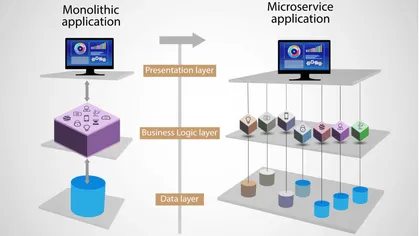
Separating the back end from the front-end presentation layer meant program content could be restructured for a new audience or funding round without rebuilding the platform underneath it. A conventional, tightly coupled CMS would have made that impossible without duplicated effort every time program information changed, and transport policy in Indonesia changes as new corridors and funding rounds come online.
3. The build balanced sophistication against maintainability.
The back end ran on PHP 8 and Laravel 8 for its MVC structure, documentation depth, and active developer community, deployed on Ubuntu Server 20.04 LTS with Nginx and MySQL or PostgreSQL. The front end used Vue.js and Nuxt.js over HTML5, SCSS, and ES6 JavaScript, with Axios and Vuex handling API communication and state, and ESLint and Prettier enforcing the code consistency that lets a codebase be easy to read, and easy for MoT's team to inherit.
4. Performance was sized to actual load, not a theoretical ceiling.
Caching ran through Redis or Memcached, with Varnish for microcaching, on a right-sized footprint of 4 vCPUs, 8 GB RAM, and 80 GB SSD storage. A larger footprint would have offered more headroom, but it would have raised the ministry's ongoing hosting cost for a platform meant to be self-sufficient.
5. Security was built in, not bolted on.
The platform was hardened against the OWASP Top 10, covering injection, broken authentication, data exposure, XML external entities, broken access control, misconfiguration, cross-site scripting, insecure deserialization, vulnerable components, and insufficient logging. For a platform holding donor and government data, this was table stakes for a ministry carrying its own compliance exposure.
6. The rollout wasn't one deployment. It was a loop that kept adjusting based on what testing found.
After development, the platform went through functional, integration, performance, and security testing, with issues resolved before deployment. Suitmedia transferred the microsite to MoT's server, confirmed functionality there, implemented SEO and analytics, and delivered an administration manual. The engagement stayed open past launch, with Suitmedia handling post-completion bug fixes and change requests as an extension of testing, not a closed chapter.
A Maintable and Useful Platform that Translates Low-Carbon Transport Expertise into Practical Guidance
1. The platform was sized to what MoT could actually sustain.
Suitmedia delivered a production platform running on 4 vCPUs, 8 GB RAM, and a minimum of 80 GB SSD storage. The back end ran on PHP 8 and Laravel 8, deployed on Ubuntu Server 20.04 LTS with Nginx 1.17.0 or above, and MySQL 8.0 or PostgreSQL 12.
2. Security was validated against a defined standard, not left to assumption.
Controls covered all ten OWASP Top 10 risk categories. The Vue.js and Nuxt.js front end went through functional, integration, performance, and security testing before deployment, with issues resolved prior to go-live.
3. The more meaningful result is qualitative, not infrastructural.
The finished platform translated sustainable urban transport frameworks, BRT corridor expertise, funding mechanisms, and emissions evaluation tools into a single structured knowledge hub, built to serve national policymakers and local government implementers without forcing either into the other's technical language.
4. Internal GIZ stakeholders validated the platform for the thing that mattered most.
It received positive validation specifically for its translation work, bridging technical expertise with practical, actionable guidance for accelerating Indonesia's low-carbon transport transition.
5. What's absent from this record is as telling as what's in it.
Post-launch traffic, adoption, or usage data were not part of what was tracked, a limitation of measurement, not a claim the platform underperformed. What is documented is that the platform was delivered, tested, secured, handed over with a working administration manual, and validated by the stakeholders responsible for the program's success.
The Deeper Lesson: A Platform Should Be Designed for Long-Term Government Ownership and Continued Use
1. Discovery work that feels slow is usually the fastest path to the right architecture.
The qualitative interview process, run before any design or technical decision, surfaced the real requirement. A platform serving multiple stakeholder types with different technical fluency, not a generic informational site. Skipping that phase for faster design work would have produced a site that looked complete and failed its actual audience.
2. Government handoff should be a design constraint from day one, not a delivery-phase afterthought.
Choosing Laravel for its documentation and community support, sizing infrastructure to actual need, and building a maintenance manual into the deliverable were not separate decisions. They were one decision, made early, to treat MoT's long-term ownership as a requirement.
3. Security hardening for a multi-donor platform is a trust mechanism, not a checkbox.
A platform carrying funding data from four governments has a credibility bar a standard corporate site does not. Building against OWASP Top 10 from the start, rather than retrofitting it, protected both the data and the program's standing with its donors. Front-load stakeholder interviews before design decisions lock, and treat the receiving organization's maintenance capacity as a hard constraint from the first architecture conversation.
Strategic Insights for the C-Suite
1. A knowledge hub for a multi-stakeholder program is an internal alignment tool before it is an external communications tool.
When a program depends on coordinated action from ministries, local governments, and international donors, the biggest risk is not underexposure. It is misalignment caused by each party working from a different version of the same information.
2. The real cost of an over-engineered platform is not the build. It is the day the vendor leaves.
Evaluate digital partners on what a platform will cost your own team to run in year two without outside help, not just what it can do at launch. Infrastructure sized to actual need, paired with real documentation, is what makes a platform an asset instead of a liability.