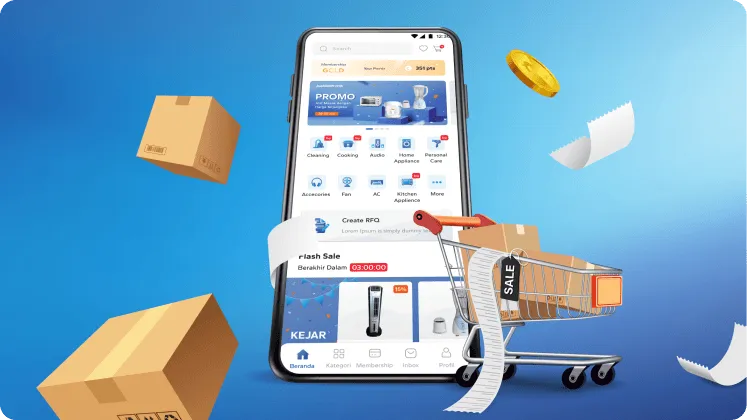
PT CSI Built a Platform for Buyers Who Already Knew What They Wanted
PT CSI runs JualElektronik, an electronics commerce platform that built its early growth serving corporate buyers, the kind of customers who arrive already knowing the SKU, spec, and quantity they need. That model worked for procurement. It wasn't built for browsing.
As mobile adoption and consumer habits shifted, CSI needed JualElektronik to sell to individual consumers who need to compare and be persuaded before they buy. CSI brought in Suitmedia to expand into a mobile-first experience and reposition JualElektronik as a destination consumers would choose to shop on.
Why a Mobile App Alone Wouldn't Have Fixed the Real Problem
1. The obvious fix was to build a mobile app that mirrored the existing website.
Port the catalog, port the checkout flow, ship it on Android and iOS, call the mobile gap closed. This would have satisfied the literal request, but it would not have solved the actual problem, because what was missing wasn't a mobile channel. It was a purchasing journey built for people who need help deciding, not people who already know what they're buying.
2. JualElektronik's entire information architecture assumes a procurement mindset
Corporate buyers search for a known part number, check stock, and reorder. That journey doesn't require product discovery, comparison tools, or persuasion, because the decision was made before the buyer ever opened the platform. Individual consumers arrive with the opposite need. They don't know which model fits their budget or use case, and they need the platform itself to guide that decision. A mobile app built on top of procurement-oriented architecture would have just made that mismatch portable.
3. The real trade-off CSI faced was whether to unify or fork the platform.
Building fully separate experiences for B2B and B2C buyers would have let each journey be optimized without compromise. It would have also split CSI's digital presence into two properties to maintain, diluting the JualElektronik brand at the exact moment CSI wanted to strengthen it. Suitmedia's strategy kept one platform and rebuilt the journey inside it, which meant accepting more design complexity in exchange for a single, coherent brand presence across both audiences.
Rebuilding the Journey Before Building the App
1. Suitmedia's strategy combined business objectives with customer experience principles.
The aim was to redesign the purchasing journey itself, so that product discovery, comparison, and transactions felt intuitive to a consumer audience, while keeping the web platform and the new mobile application consistent with each other rather than fragmenting CSI's digital presence across channels.
2. The build was sequenced so each stage informed the next.
Suitmedia started with Mobile Application Development for Android and iOS, extending reach to where consumer shopping behavior was already heading. That step alone would have solved access, not adoption, so it was followed by a UX/UI Redesign aimed at simplifying navigation and usability for end users rather than corporate procurement teams. That redesign is what actually addressed the root cause. It shifted the underlying journey logic from "find the known SKU" to "help me decide what to buy."
3. Consistency between web and mobile was a deliberate constraint.
Suitmedia could have optimized the mobile app aggressively for consumer behavior while leaving the website closer to its original B2B design. That would have sharpened the mobile experience faster. It would have also meant CSI's two channels told two different stories about what JualElektronik is, undermining the repositioning it was trying to achieve. Suitmedia chose a consistent omnichannel experience across both, which meant the web platform absorbed some of the same redesign discipline as the app instead of being left as a legacy interface running alongside a modern one.
What CSI Reveals About Repositioning a Platform
1. Mobile-first is an information architecture decision.
Shipping an app does not fix a platform's underlying logic. If the journey underneath still assumes the buyer already knows what they want, the mismatch just becomes portable instead of disappearing.
2. Trust infrastructure comes from product discovery.
In B2B commerce, buyer familiarity and account relationships substitute for guidance. In B2C commerce, nothing substitutes for it unless the platform builds it in. Comparison tools and recommendation engines exist to do the job a salesperson would otherwise do.
3. Cross-channel consistency protects a repositioning effort from undermining itself.
A platform cannot credibly reposition as consumer-first on mobile while still behaving like a procurement tool on desktop. Treating both channels as one journey is what keeps a repositioning story coherent to the customer.
Before greenlighting a mobile build for a platform serving two very different buyer types, map which parts of the existing journey assume the buyer already knows what they want. Redesign those first.
Strategic Insights for the C-Suite
1. Repositioning a B2B platform for consumer audiences is an architecture problem before it's a channel problem.
Executives evaluating a similar move should resist treating "we need an app" as the fix. The deeper question is whether the platform's existing journey logic assumes a buyer who already knows what they want, because that assumption, not the absence of a mobile app, is usually what's actually blocking consumer adoption.
2. Unifying two audiences on one platform is a brand decision with a real cost.
Forking into separate B2B and B2C experiences would optimize each journey independently, at the cost of a fragmented digital identity and duplicated maintenance. Keeping one platform preserves brand coherence, at the cost of carrying more design complexity inside a single system.
Before committing to either path, decide explicitly which you're optimizing for: journey purity for each audience, or one brand story told consistently across both. Don't let that decision get made by default.