
The Paradox of Bureaucracy in the Digital Age
Indonesia's citizens faced a persistent friction: accessing government services required navigating a labyrinth of separate websites, phone lines, and physical offices scattered across 17+ ministries and agencies. A citizen needing a business license, health certificate, or pension update had no central reference point. Instead, they searched blindly, called multiple departments, or simply gave up.
This wasn't a technical problem. It was a governance problem. The Presidential Unit of Supervision and Control of Development (UKP4)—Indonesia's open government initiative—recognized that the country had already digitized many individual services. What was missing was a coherent platform that made all of them discoverable and accessible from one place. The citizen experience was fragmented because the government remained fragmented.
UKP4 partnered with Suitmedia to build Satulayanan.id, a unified portal for public services. The ambition was simple but radical: let one Indonesian website become the trusted gateway to all 360 government services available across the country.
Structural Barriers to Unified Public Access
Building a national public services portal meant confronting challenges that transcended design and technology.
1. Information fragmentation across 17+ government divisions.
No single entity owned "government services." Each ministry—Health, Finance, Interior, Labor—maintained its own digital presence, with different information architectures, terminology, and update schedules. A citizen searching for "business permit" might find it called "izin usaha," "SIUP," or "NIB" depending on which agency's website they landed on.
Suitmedia had to physically inventory 360+ services, standardize descriptions, and create a unified taxonomy that made sense to citizens—not bureaucrats. This wasn't a data entry. It was archeological work: finding the real information buried inside outdated PDFs, inconsistent databases, and institutional silos.
2. The incentive problem: Why agencies had no motivation to cooperate.
Government agencies didn't benefit from consolidation. In fact, fragmentation protected them. A citizen who couldn't find a service on the main website might call the agency directly, generating phone traffic and justifying larger budgets. A unified portal threatened that logic.
UKP4 had political authority, but not direct power over ministries. Suitmedia had to design the platform in a way that made participation valuable for agencies—by increasing visibility, improving citizen satisfaction, and making their services measurable. The portal wasn't a threat to agencies; it was a promotion platform.
3. The content problem: Stale, outdated, or contradictory service descriptions.
Many government service pages hadn't been updated in years. Requirements listed on one ministry's site contradicted another ministry's documentation. Processing times were estimates, not guarantees. Fee structures changed without notice.
Suitmedia couldn't solve this by design alone. The platform needed a feedback mechanism—a way for citizens to flag errors, report outdated information, and ask clarifying questions. This crowdsourced validation would help identify and fix inconsistencies faster than official update cycles.
4. The access barrier: Making the portal work on Indonesia's actual device landscape.
In 2013, Indonesia's internet infrastructure was fragmented. Broadband was expensive and slow. Many citizens accessed government services on low-end Android phones, 3G networks, or even feature phones with mobile web browsers.
Designing for "mobile" wasn't a nice-to-have feature request. It was a foundational requirement. If Satulayanan.id didn't work on a slow 3G connection or a six-year-old device, it was useless for the citizens who needed it most.
5. The trust problem: Why would citizens even use this portal?
A new government website could easily become another abandoned digital project. Citizens had learned to distrust government websites. Why spend time on Satulayanan.id when they could just call an agency directly?
The portal needed to demonstrate immediate value and reliability. If a citizen followed Satulayanan.id's instructions and the service actually worked—they'd return. If they wasted time chasing outdated information, they'd abandon the platform and the government's credibility would decline further.
Redesigning Government as a Platform
Suitmedia's approach treated the problem as a service design challenge, not a technology challenge. The architecture needed to solve for citizen behavior, not just agency convenience.
Design Principles That Shaped the Solution
1. Universal discoverability through simple categorization.
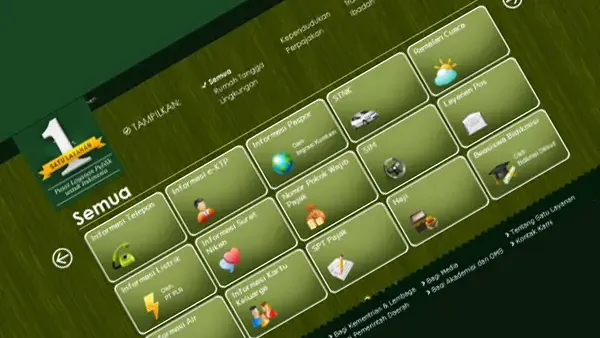
Satulayanan.id organized 360+ services into logical categories (Business, Health, Education, Social Services, Legal) visible on the homepage. Citizens didn't need to know which ministry handled their needs—they could browse by life event or activity.
A grid layout made navigation immediate and visual. No nested menus, no bureaucratic jargon, no requirement to "know the system." A citizen could scan the homepage in seconds and find what they needed. The simplicity was deceptive—it masked months of work standardizing how services were named and categorized across government.
2. Powerful search that spoke citizen language, not bureaucratic language.
Behind the grid was a search engine trained on citizen vocabulary, not official terminology. A user could search "business license," "work permit," "health checkup," or even colloquial terms, and the system would return relevant services.
This required mapping citizen language to official service names—"I want to start a business" to "Izin Usaha Perdagangan (SIUP)" to "Nomor Identitas Berusaha (NIB)." The search algorithm also learned from usage patterns: if hundreds of citizens searched for "X" but couldn't find it, the team knew a service description needed revision or a redirect was missing.
3. Complete service information structured for real workflows.
Each service page followed a consistent template: what the service does, who is eligible, what documents are needed, how long it takes, how much it costs, where to apply (online or offline), and contact information for the relevant agency.
This seems obvious in retrospect. But government websites typically buried this information across multiple PDFs or provided only fragments. Satulayanan.id made the full picture visible so citizens could prepare before visiting an office or portal. The consequence: fewer wasted trips, fewer incomplete applications, and faster processing.
4. A public forum where citizens could voice problems and share solutions.
Satulayanan.id included a discussion column where citizens could ask questions about services, report outdated information, and share tips with other users. This wasn't a complaint box—it was a feedback mechanism that signaled citizen agency.
A citizen who discovered that a service page was out of date could report it. Other citizens with firsthand experience could confirm or correct information. UKP4 and relevant agencies monitored these discussions and prioritized updates based on frequency of questions. The forum transformed the portal from static reference into a living knowledge base.
Mobile-First Construction for Fragmented Infrastructure
In 2013, designing for "mobile" meant accepting Indonesia's actual constraints, not Silicon Valley's idealized version.
1. The site was built with progressive enhancement.
The core experience—finding and understanding a service—had to work on any device, any connection speed, any browser. HTML was lean. Graphics were optimized for slow networks. The grid layout adapted seamlessly from desktop to tablet to phone without breaking functionality.
A citizen on a 3G connection should see a full service description in under 5 seconds. A citizen on a feature phone with mobile web support should still be able to search and read. This required discipline: every image was compressed, every interaction was essential, every byte counted.
2. The platform was designed for offline-first access patterns.
Many citizens didn't have reliable internet at home. They'd access Satulayanan.id at an internet café, take notes, or download PDFs of service requirements. The site optimized for this workflow: service pages were easy to screenshot or print, requirements were clearly listed, and contact information was prominent enough to copy by hand.
Later versions experimented with offline capabilities, but the core principle was constant: assume connectivity is a luxury, not a baseline.
3. Integration with government digital infrastructure was minimal but strategic.
Satulayanan.id didn't try to become a transaction platform immediately. It remained a discovery and information portal. Citizens learned about services on Satulayanan.id, then applied through official government websites or offices. This reduced technical complexity and didn't threaten existing government systems.
However, the platform was structured so that future integration would be possible. If a ministry built an API for service applications, Satulayanan.id could link directly to it. The foundation was laid for eventual one-stop transactions—without requiring all agencies to upgrade simultaneously.
Scaling Through Crowdsourced Accuracy
Satulayanan.id's real innovation wasn't the design or technology. It was the operational model for keeping 360+ service descriptions current and accurate.
1. UKP4 employed a small editorial team, not large.
Instead of hiring dozens of content managers to update service descriptions, the platform invested in moderation tools and community guidelines. Citizens and agency staff could flag outdated information. The editorial team prioritized updates based on volume and severity of reports.
This created a flywheel: the more people used the platform, the more feedback appeared, and the faster outdated information was corrected. Usage itself became a quality control mechanism.
2. Agency participation was incentivized through visibility and legitimacy.
Ministries didn't have to update their own content on Satulayanan.id. UKP4's team handled that. But agencies saw the value: their service appeared in a unified, authoritative government portal—improving discoverability and citizen satisfaction.
Some agencies began treating Satulayanan.id as the source of truth for their own service descriptions. If something was outdated on the portal, they'd contact UKP4 to correct it. The portal became a shared accountability tool, not an external audit.
3. The discussion forum became an early warning system.
When citizens repeatedly asked the same question about a service, it signaled that the service description was unclear or outdated. The editorial team monitored forums for patterns and prioritized updates accordingly.
A question like "How do I apply for this online?" appearing 50 times meant the application process wasn't clearly explained. The team would revise the description or add a link to the actual application. The crowd was doing quality assurance work for free.
The Broader Impact: When Access Changes Behavior
Satulayanan.id launched in 2013 and achieved something rarer than most government digital projects: sustained usage and demonstrated value.
1. Citizens used it as an authoritative reference.
Within months, Satulayanan.id became the default starting point for Indonesians seeking government services. Search engines ranked it highly for service-related queries. NGOs and civil society organizations referenced it as the authoritative compendium of Indonesian public services.
This wasn't because the platform was technologically sophisticated. It was because it solved a real, daily problem. A citizen who'd previously spent hours calling different agencies could now spend 10 minutes on Satulayanan.id and have all the information they needed.
2. Government agencies began treating service descriptions as strategic assets.
Once services were visible on a unified platform, agencies realized they were competing for citizen attention. Poorly described services got fewer inquiries. Clear, helpful service pages attracted users.
This created unexpected incentive alignment: agencies started writing better service descriptions, providing clearer requirements, and reducing unnecessary bureaucracy. The portal didn't change the law—it changed the incentive structure by making service quality visible and measurable.
3. The platform reduced friction in citizen-government interaction.
Citizens armed with complete information made fewer mistakes in applications. Processing times improved because fewer applications were rejected for missing documents. Agency phone lines received fewer confused calls. The entire system became more efficient.
This second-order effect wasn't the original goal, but it was the ultimate impact. Satulayanan.id didn't just improve information access—it improved the actual delivery of government services.
4. Mobile access enabled participation from previously excluded citizens.
Citizens without computers could access Satulayanan.id on their phones. Elderly citizens, rural residents, and working-class Indonesians who couldn't travel to internet cafés during business hours could check requirements at night on their mobile phones.
The platform didn't eliminate barriers for the most marginalized—those without phones or connectivity. But it removed a barrier for millions of Indonesians for whom mobile was the primary (or only) internet device.
Lessons About Government Digital Transformation
Building a national public services portal revealed lessons that apply far beyond Indonesia.
1. Coordination is harder than technology.
The technical challenge of building Satulayanan.id was straightforward: create a searchable database with a clean interface. The real challenge was political and organizational: getting 17+ ministries to cooperate, standardizing information, and building trust across government silos.
Suitmedia's role wasn't primarily to write code. It was to facilitate coordination. The platform worked because UKP4 had authority and political will, and because the design made participation rewarding for agencies. Technology enabled the solution, but organizational alignment enabled the platform.
2. Crowdsourced correction at scale works for the government.
In the private sector, companies hire content teams to keep information current. The government can't afford this at scale. Satulayanan.id proved that citizens will help correct information if the mechanism is simple and they feel heard.
The lesson: build infrastructure for citizen feedback, and prioritize updates based on what citizens report. Let usage patterns guide resource allocation. The crowd's questions are data about what the system is failing to explain.
3. Mobile-first access expands the addressable population.
Designing for desktop would have limited Satulayanan.id to middle-class Indonesians with computer access. Designing for mobile meant reaching citizens who accessed government services through their phones. This wasn't "nice to have"—it was the difference between a useful tool for some and a useful tool for many.
The lesson applies broadly: in any emerging market context, "mobile-first" isn't a design trend. It's a recognition of how the actual population accesses digital services.
Strategic Insights for the C-Suite
1. Government digital transformation is about removing friction, not adding features.
Satulayanan.id succeeded by solving one problem cleanly: making 360 government services discoverable and understandable. It resisted scope creep—it didn't try to process transactions, collect payments, or integrate all government databases. A unified information portal was enough to change citizen behavior.
The lesson: in transformation projects, especially in government, focus on eliminating a single critical friction point. Solve that completely, build trust, and expand from there. Feature bloat is a distraction.
2. Agency coordination works when participation is optional and beneficial.
Satulayanan.id didn't mandate participation. It made agencies want to participate because visibility and citizen satisfaction improved. The portal wasn't a mandate from above—it was an asset that agencies saw value in using.
This applies to any large-scale coordination challenge: design incentives so that participation is voluntary and beneficial. If agencies only participated because they were forced to, they'd update information poorly or subvert the system. Instead, they improved descriptions because they saw the payoff.
3. Crowdsourced feedback is a feature of the product, not a bug fix.
Many organizations treat user feedback as a support cost—complaints to be managed. Satulayanan.id integrated feedback directly into the product: the discussion forum was a primary feature, and citizen reports drove prioritization.
This reframes community feedback from "we have to listen to complaints" to "our users are helping us build a better product." It's a different relationship with your users, and it leads to faster iteration and more robust solutions.
4. Access expands the addressable population and changes behavior.
By making government services accessible on mobile phones, Satulayanan.id reached citizens who previously couldn't easily access this information. This didn't just add a new user segment—it changed how citizens interacted with the government.
Citizens who knew their requirements upfront made better applications. Agencies received fewer incomplete submissions. The entire interaction improved. The lesson: when you remove access barriers, you don't just serve more people—you change how the system works.
5. Authenticity and authority matter more than polish in government services.
Satulayanan.id wasn't designed to be flashy. It was designed to be trustworthy, complete, and accurate. Citizens cared more about whether information was current and correct than about visual design.
In government and public-facing platforms, authority and reliability outweigh aesthetic polish. Build for accuracy, clarity, and trust first. Design elegance is secondary. A plain website with accurate, current information beats a beautiful website with stale data.