
The Faith-Information Crisis in Indonesia
Indonesia is home to 230 million Muslims—the world's largest Muslim-majority democracy. Yet a structural problem persists: reliable Islamic knowledge remains fragmented across institutions, geographies, and interpretation frameworks.
A Muslim in Jakarta seeking clarity on a religious question has options: consult a local imam, contact the Council of Indonesian Ulama (MUI), reach out to Nahdlatul Ulama or Muhammadiyah, or search online—where they encounter a cacophony of contradictory sources, unverified fatwas, and content designed for engagement rather than accuracy.
The problem compounds when a trending topic touches religion: a dietary question, a prayer protocol during travel, a ruling on a contemporary practice. Social media explodes with opinions; misinformation spreads faster than correction; Muslims end up uncertain whether their actions align with their faith.
Teman Muslim's founding insight was simple: the gap isn't between Muslims and Islamic knowledge—it's between Muslims and trustworthy Islamic knowledge delivered at the moment they need it, integrated into their daily worship practices.
The Platform Fragmentation Problem: Why Existing Apps Fail
The Indonesian Muslim app ecosystem was crowded but fragmented, each platform solving one problem while creating others.
The Feature-Credibility Trade-Off
Prayer time apps worked beautifully—they delivered accurate prayer schedules, qibla direction, and Quranic recitations. But they were worship-focused silos. A user wanting to understand a question about halal food, inheritance law, or fasting exceptions had to abandon the app and search elsewhere.
Islamic knowledge platforms (news sites, fatwa databases, educational portals) existed but lacked worship integration. You'd go to these sites for information, then switch to a separate app for prayer times. This friction fragmented the user's spiritual experience into disconnected tools.
The Trust Problem at Scale
The deeper issue was epistemic: How do you know if Islamic information is reliable?
Many platforms aggregated content without curation. A trending question might trigger dozens of responses from unnamed sources, self-proclaimed scholars, or interpretations rooted in specific schools of thought without context. A Muslim seeking guidance couldn't easily distinguish between fatwa (formal legal opinion) and personal interpretation, between mainstream and fringe views.
This created real consequences. Misinformation about prayer protocols spread virally. Incorrect halal rulings influenced purchasing decisions. Theological disputes that should have been framed as jurisprudential differences got presented as moral truths. Users ended up either paralyzed by conflicting advice or confident in guidance that was simply wrong.
Why Ad-Supported Models Corrupted the Mission
Most successful mobile apps monetize through advertising. But advertising creates perverse incentives on religious platforms. Engagement-driven algorithms amplify sensational content, controversy, and divisive interpretations—exactly what shouldn't be prioritized in religious guidance.
A prayer app with banner ads every five minutes turns worship into an interrupted experience. A knowledge platform optimized for clicks rather than accuracy serves the advertiser, not the user.
Teman Muslim's founding team recognized this fundamental misalignment: a platform genuinely serving Muslim spiritual needs couldn't be sustained on advertising. It needed a different model—one aligned with the platform's mission rather than opposed to it.
Designing for Trustworthy Knowledge and Uninterrupted Worship
Teman Muslim's approach inverted the typical app development process: instead of building features and iterating based on usage data, the team started with deep research to understand what Muslims actually needed and what would genuinely serve their faith.
1. Research-First Architecture
Before writing a single line of code, Teman Muslim conducted extensive qualitative research with target users across different demographics, geographies, and Islamic traditions.
This research revealed several non-obvious insights:
- Worship features weren't optional extras—they were core to how users engaged with Islamic apps daily. A person checking prayer times multiple times each day was a consistent user; this behavior created a retention hook.
- Context mattered for Islamic questions—the same question (e.g., "Is this food halal?") had different answers depending on the user's location, school of Islamic jurisprudence, and specific circumstances. Generic answers weren't trustworthy; contextual guidance was.
- Users wanted to share learning with the community—Islam in Indonesia is practiced communally. A single person's question often becomes a family or mosque community discussion. Apps that facilitated sharing multiplied their impact.
- Reliability required institutional backing—users wouldn't trust a random scholar's interpretation. But they trusted MUI (the official fatwa authority), respected Islamic organizations like Nahdlatul Ulama and Muhammadiyah, and were reassured by government religious affairs ministry involvement.
This research drove every subsequent design decision. Rather than copying features from successful apps, Teman Muslim designed from first principles: "What do Muslims actually need to live their faith in the digital age?"
2. Institutional Partnership as a Core Feature
Teman Muslim made a structural choice that most startups would consider economically irrational: partner with established Islamic institutions for content validation rather than building the platform first and finding institutional support later.
This meant:
- MUI fatwa validation: Major questions routed to or validated by the Council of Indonesian Ulama ensured users got official guidance on contested issues
- Nahdlatul Ulama and Muhammadiyah representation: Both organizations provided interpretive frameworks reflecting their jurisprudential traditions, giving users understanding of how Islamic law differs across schools of thought
- Ministry of Religious Affairs integration: Government religious affairs ministry provided official resources and credibility
Rather than trying to be neutral (impossible on religious matters), Teman Muslim became transparent about whose interpretations were represented. This transparency was itself a trust signal: users knew they were getting guidance from named, credible institutions, not anonymous crowdsourced opinions.
3. Worship as the Core Experience
The app's architecture placed worship features at the center, not the periphery.
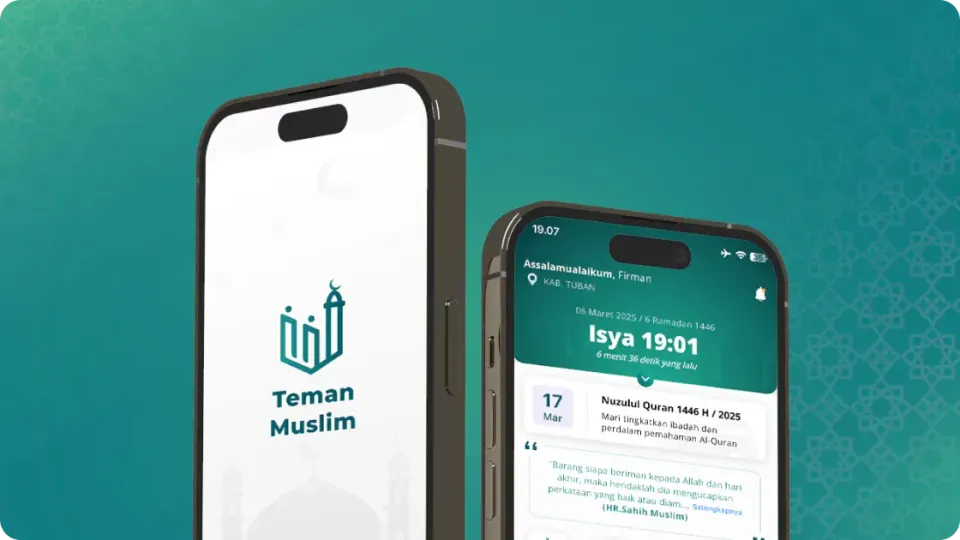
Prayer Times and Notifications: Accurate prayer time calculations for the user's location, with notification systems that helped users maintain consistency. But unlike other prayer apps, these weren't treated as informational—they were designed as spiritual reminders. A notification at Asr wasn't just a time announcement; it was framed as an invitation to worship.
Quranic Recitation: High-quality Quranic audio recitations with Tajweed (correct pronunciation) from recognized qaris (Quranic reciters). This served both worship (users could listen during prayer) and learning (users could study Quranic pronunciation and meaning).
Prayer Tracking: A feature that seemed simple but served important psychological functions. Users could log their prayers, creating a personal record of spiritual consistency. This addressed a common Muslim practice—many Muslims keep mental or written records of their prayers as a form of accountability.
Qibla Direction: Precise qibla (direction of prayer) calculation using device GPS and compass, essential for prayer validity. This was table stakes for any Muslim app, but Teman Muslim implemented it with exceptional accuracy.
Critically, none of these features included advertising or distracting elements. The worship experience was sacred space—no banners, no interruptions, no commercialization. This design choice reflected a deep understanding of what Muslim users needed: a tool that respected the spiritual act of worship rather than exploiting it for ad impressions.
4. Knowledge Architecture: Verified Information at the Point of Need
Teman Muslim created a knowledge layer separate from but integrated with worship features. Users could:
- Ask questions within the app (or select from trending questions others had asked)
- Receive answers vetted by institutional partners before publication
- Understand context through explanations of which Islamic school of thought the answer reflected and why interpretations might differ
- Go deeper with linked resources—Quranic verses, Hadith (prophetic traditions), scholarly commentary
The key design principle was reducing steps between question and trustworthy answer. Instead of:
- Open app
- Go to knowledge section
- Search for question
- Evaluate source credibility
- Read answer
- Return to prayer app
The user could:
- Think of a question while using worship features
- Click "Ask" (always available)
- Get routed to vetted answer within minutes
This seamless integration between worship and knowledge reflected how Islam actually functions: believers encounter questions naturally during spiritual practice, and they need guidance at that moment, not later when they've researched alternative sources.
5. Community Features Without Algorithmic Fragmentation
Teman Muslim included sharing and community features—users could share learning with family, mosque groups, or Islamic study circles. But these features were designed explicitly to avoid algorithmic amplification.
No recommendation algorithm ranked content by engagement. No personalized feed optimized for time-on-app. Instead:
- Users saw institutional content in chronological order
- Community sharing was opt-in, not algorithmic
- Trending topics were determined by institutional curation, not engagement metrics
This design choice directly opposed how most social platforms work. But it served the core mission: a platform optimizing for user growth through engagement would inadvertently amplify sensational, divisive, or misleading content. Teman Muslim instead optimized for accuracy and institutional credibility, even if this meant slower growth.
6. Technical Implementation for Reliability
Teman Muslim was built on modern web technologies (HTML, CSS, JavaScript) compiled for iOS and Android. This technical stack allowed:
- Cross-platform consistency: Users on iPhone and Android had identical experiences
- Offline functionality: Core features (prayer times, Quran, stored knowledge) worked without internet, essential for users in areas with inconsistent connectivity
- Fast performance: Minimal data usage and quick load times respected users' data constraints and attention
The technical implementation was competent but unremarkable—the differentiator wasn't the engineering, it was the institutional partnerships and design philosophy that the engineering served.
How a Values-Aligned Platform Develops Differently
Teman Muslim's development process diverged from typical startup playbooks in ways worth examining.
The Internal Project Advantage
Because Teman Muslim was developed as an internal project (rather than as a client deliverable), it had different pressures and opportunities:
- Longer time horizons: The team could invest heavily in research and institutional partnerships before rushing to market
- Mission alignment over growth: Decisions weren't driven by investor return expectations or venture capital timelines; they were driven by "Does this serve the mission?"
- Institutional credibility: Being embedded within Suitmedia (an established firm) gave Teman Muslim legitimacy in conversations with MUI, religious affairs ministry, and Islamic organizations
This doesn't mean the project was subsidized forever—eventually it would need to be financially sustainable. But the runway allowed the team to build the right foundation rather than the fastest foundation.
Research-Before-Features Discipline
Most apps follow this cycle: launch MVP → collect usage data → iterate. Teman Muslim inverted this: research extensively → design from principles → launch with complete feature set.
This meant:
- Fewer post-launch pivots (because the foundational research was comprehensive)
- Better feature prioritization (because users had articulated what they actually needed)
- Stronger institutional partnerships (because the team had invested months understanding what organizations needed to provide content)
The downside: slower time to market, higher upfront costs. The upside: a coherent product that worked for users from launch rather than a half-baked MVP that required extensive iteration.
Sustainability Without Exploitation
Teman Muslim eliminated advertising completely. For a mobile app, this is a radical choice. But it forced clarity about the business model.
The founding team explored several approaches:
- Freemium model: Core features free, premium features (deeper Islamic learning, advanced prayer customization) paid
- Institutional subscription: Organizations like mosques, Islamic schools, or Islamic organizations pay for enterprise licenses
- Grant funding: Nonprofits and religious organizations fund the platform as a public good
- User donations: Voluntary contributions from users who value the platform
By 2024, Teman Muslim was exploring combinations of these, with emphasis on sustainability that didn't corrupt the mission (ruling out algorithmic engagement optimization or attention extraction).
What Early Traction Reveals
By early 2024, Teman Muslim had achieved:
- 359 total downloads (209 Android, 150 iOS)
- 320 active users (212 Android, 108 iOS)
- Consistent engagement: Users returning regularly to check prayer times, access Islamic knowledge, and share with communities
These numbers might seem modest compared to consumer apps with millions of users. But they tell a crucial story about product-market fit for a mission-driven platform.
Why These Numbers Matter
The user acquisition wasn't driven by viral growth hacking, paid advertising, or network effects. It came from:
- Institutional endorsement: Users discovered the app through MUI, Islamic organizations, and mosques that recommended it
- Word-of-mouth in religious communities: Users shared the app within Islamic study circles and community groups
- Genuine utility: People kept using it because it solved a real, recurring problem (finding trustworthy Islamic information + managing daily prayer)
The active user ratio (320 active out of 359 downloaded) is exceptionally high. Typical consumer apps see 20-30% active user ratios; Teman Muslim is at 89%. This suggests that people who download the app find it genuinely useful and integrate it into their daily spiritual practices.
Predictable Growth Trajectory
The team's growth projections aren't based on viral loops or network effects (which don't apply to prayer apps). They're based on:
- Gradual expansion of institutional partnerships: As more mosques, Islamic schools, and organizations recommend the app, download growth accelerates through trusted channels
- Geographic expansion: The app's initial focus was Java and Bali (where Suitmedia's network is strongest); expansion to Sumatra, Kalimantan, and eastern Indonesia brings new user cohorts
- Feature maturation: As the app deepens its knowledge base (more answered questions, richer Islamic resources), it becomes more valuable for users seeking guidance
This growth model is slower than a venture-backed consumer app, but it's resilient. It's based on delivering genuine value, not on exploiting attention or creating artificial urgency.
What Designing for Faith Taught Teman Muslim
1. Credibility is structural, not cosmetic.
Users don't trust a religious app because of good design, engaging content, or influencer endorsements. They trust it because it's backed by institutions they already trust. Teman Muslim's institutional partnerships weren't a growth tactic—they were the foundation of trustworthiness. For any platform serving communities with high credibility requirements, credibility must be built into the architecture, not layered on top.
2. Ad-free is a feature when the core activity is sacred.
Advertising on prayer apps or Islamic knowledge platforms creates a fundamental misalignment. It treats users as attention assets to be monetized rather than people seeking spiritual guidance. Teman Muslim's commitment to ad-free experience wasn't just virtuous—it was strategically essential. Users trusted the platform because they knew it wasn't optimizing their engagement for profit.
3. Slow growth through trusted channels beats viral growth from uncertain sources.
Teman Muslim's growth is measured in hundreds of active users, not millions. But these users came through mosques, Islamic organizations, and community recommendations—channels with built-in credibility and accountability. Viral growth could have been achieved through engagement optimization, but it would have attracted users primarily interested in entertainment rather than genuine Islamic guidance.
4. Mission clarity attracts aligned partners.
Teman Muslim's explicit commitment to trustworthy Islamic knowledge attracted institutional partnerships that a typical startup wouldn't secure. MUI, Nahdlatul Ulama, and the Ministry of Religious Affairs engaged because the platform's mission aligned with their own. Many startups try to pursue mission alignment as an afterthought; Teman Muslim made it foundational.
5. Design for the actual use case, not the idealized one.
Most Muslim apps assume users engage deeply with complex religious questions. But the actual use case is simpler: users check prayer times multiple times daily and occasionally have a specific question. Teman Muslim's design reflects this reality—worship features are primary, knowledge features are secondary but always accessible. Designing for how people actually use apps, not how we think they should, drives adoption and retention.
Strategic Insights for the C-Suite
1. Mission-driven platforms require different growth metrics than engagement-optimized apps.
Teman Muslim's active users might seem insignificant compared to consumer apps. But the cohort retention (89%), the daily engagement (multiple prayer time checks), and the community impact (users sharing with mosques and study groups) indicate a healthy product. Boards and investors often push mission-driven startups to adopt consumer app metrics (DAU, engagement time, viral coefficient). Resist this pressure. Design metrics that reflect your actual mission—user trust, community impact, institutional credibility—rather than metrics borrowed from entertainment apps.
2. Institutional partnerships are assets, not distractions, in mission-driven contexts.
Startups typically see institutional engagement as slow and bureaucratic. But for platforms requiring high credibility, institutional partnerships are core assets. They provide content validation, distribution channels (mosques recommending apps to congregations), and built-in audiences. Invest heavily in these partnerships early, even if they slow time-to-market. They create defensibility that competitors can't easily replicate.
3. Eliminating revenue streams can be more strategic than including them.
By eliminating advertising completely, Teman Muslim made a choice that reduced short-term revenue potential but protected long-term credibility. For platforms where trust is the fundamental asset, any revenue model that creates misalignment with users' interests is strategically shortsighted. This applies beyond religious apps—it applies to any platform where user trust is essential and fragile.
4. Sacred experiences deserve design approaches distinct from entertainment or commerce.
Prayer apps, platforms serving medical information, mental health resources, and educational tools serve different user psychological states than entertainment apps. They shouldn't be designed using the same engagement frameworks. Teman Muslim's design treated worship as sacred space—no distractions, no commercialization, no algorithmic manipulation. For any platform serving sacred or high-trust contexts, adopt design ethics aligned with the context, not borrowed from social media.
5. Slow, credible growth in underserved communities beats fast, shallow growth in competitive markets.
Teman Muslim entered a crowded Muslim app ecosystem. Rather than trying to out-innovate or out-market competitors, it identified an underserved need (trustworthy institutional knowledge integrated with worship features) and served it deeply. The growth is measured and built on credibility, not hype. For any startup, this principle applies: find a genuine gap that competitors haven't filled well, serve that gap credibly, and grow through genuine user satisfaction rather than through growth hacking.