
How Simplification Became the Competitive Advantage in a Crowded Market
The Hidden Cost of Manual Complexity
Yamaha Motor Indonesia occupied an enviable position: market leader in one of the world's most vibrant two-wheeler markets. Indonesia's motorcycle obsession is real. Motorbike sales dwarf car sales by a factor that would shock Western markets. Every street corner has a dealer, every neighborhood has riders, and new model launches generate genuine excitement.
But market leadership created a hidden problem. As Yamaha launched new models, the process became increasingly complicated. Each launch required coordinating across technical teams, distribution networks, dealer channels, and promotional campaigns. Information fragmented across systems. Customer interest spiked, but the sales infrastructure couldn't keep pace. Dealers were overwhelmed. Customers got frustrated. Deals fell through.
The core challenge wasn't demand. It was friction. A customer who wanted to buy a Yamaha had to navigate multiple channels: dealer phone calls, showroom visits, paperwork shuffles, payment coordination. What should have been a 15-minute decision became a multi-day ordeal. And in a market with dozens of competitors, any friction meant the customer would simply walk across the street.
Yamaha needed a different path. Not a marketing campaign. Not a sales incentive. But a fundamental redesign of how customers could access and buy their products.
Why Traditional Dealer Networks Were Becoming Bottlenecks
Indonesia's motorcycle market is distributed and fragmented. Dealers operate independently, with varying quality of customer service and inventory management. Yamaha's brand was strong, but the customer journey to purchase was weak.
1. The Information Asymmetry Problem
A potential customer interested in Yamaha's newest bike had to physically visit a dealer to see options, compare features, and understand pricing. There was no centralized source of truth about specs, pricing, or availability across all dealers.
This created frustration on both sides. Customers didn't want to spend hours dealer-hopping to compare models. Dealers didn't have real-time visibility into which customers were interested in which bikes. A dealer might have inventory of a model nobody in their area wanted, while another dealer had customers waiting for stock.
2. The Inventory Mismatch
Yamaha's distribution system was optimized for volume, not visibility. Bikes got shipped to dealers based on historical patterns and aggregate forecasts. But a specific customer interested in a specific model in a specific color at a specific price point couldn't find that combination without calling multiple dealers.
This meant lost sales. A customer might abandon their purchase intent because they couldn't find the exact configuration they wanted. Or they might buy from a competitor who had better inventory visibility.
3. The Trust Barrier for New Customers
New motorcycle buyers—especially younger buyers—were often first-time purchasers. They didn't know dealers. They didn't know Yamaha's pricing conventions. They didn't know if they were getting a good deal or being overcharged.
This made them hesitant to commit. They'd visit a dealer, get a quote, then spend days researching to make sure they weren't being scammed. Some would abandon the purchase entirely because the friction seemed too high for a category they didn't fully understand.
4. The Operations Complexity
From Yamaha's side, each new model launch required coordinating information across dealers, managing promotions, handling order fulfillment, and processing customer data. There was no systematic way to track conversion funnels or understand where customers were dropping out.
A dealer network is powerful for distribution, but it's terrible for data collection and customer insight. Yamaha had limited visibility into its own sales process.
The Architecture of Frictionless Purchase Intent
Suitmedia's insight was deceptively simple: the best way to manage complexity is to eliminate it from the customer's view. This meant creating a single, unified digital front door where a customer could research, configure, and commit to purchasing a Yamaha motorcycle without ever walking into a dealership.
1. The Journey as the Core Design Principle
Instead of designing pages or features, Suitmedia designed a customer journey. The team mapped out exactly what a buyer needed to do from first interest to completed booking, then removed every step that wasn't essential.
The resulting flow was stripped down:
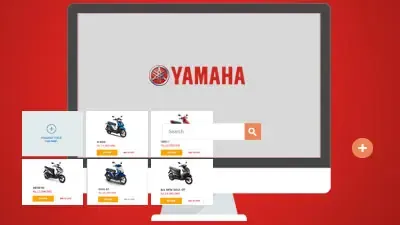
- See the bike. Product information, specs, images, and pricing all on one page.
- Configure it. Choose your color, features, and payment method.
- Choose your dealer. Select which dealer you wanted to purchase from.
- Confirm and book. Enter basic personal information and complete the transaction.
That's it. No unnecessary steps. No distracting sidebars. No "related products" trying to upsell. Every element served one purpose: moving the customer toward booking.
2. Reducing Cognitive Load Through Information Architecture
The online booking system faced a fundamental UX challenge: how do you present all the information a motorcycle buyer needs without overwhelming them?
The answer was hierarchy and progressive disclosure. The system showed buyers just enough information to make their next decision, then revealed more based on their choices. A buyer didn't see all 50 specifications upfront. They saw the key differentiators (engine power, fuel efficiency, comfort features), and if they wanted technical details, they could dig deeper.
For each model, the system prominently displayed:
- Price point. No ambiguity. The buyer knew exactly what they'd pay.
- Key features. The 3-4 attributes that differentiated this model from competitors.
- Availability. Which dealers had inventory of this exact configuration.
- Payment options. Cash or credit, with clear terms.
Everything else was secondary.
3. Speed as a Retention Strategy
Pages had to load instantly. Content had to be concise. Every element had to earn its place on the screen.
Suitmedia ruthlessly eliminated "nice-to-have" content. No lengthy product descriptions. No brand storytelling. No corporate messaging. Instead, the system used short, benefit-focused copy. "Powerful acceleration." "Comfortable all-day ride." "Fuel-efficient engine."
This wasn't lazy design. It was intentional. Every kilobyte removed from the page load time, every word removed from a description, every visual element that wasn't a call-to-action—these were deliberate choices to keep the customer's attention focused.
The psychological effect: speed communicates confidence. A fast, minimal interface tells the buyer that Yamaha is so secure in its product, it doesn't need to oversell. You know what you want. Let's get you to it.
4. Transparency as Trust Builder
For many Indonesians, buying a motorcycle from an unknown online source felt risky. What if you get scammed? What if the bike doesn't match the description?
The booking system addressed this through radical transparency. Pricing was non-negotiable and identical across all dealers. Product specifications were standardized. Dealer information was displayed clearly. The payment process was secure and trackable.
By removing the haggle, removing the variability, and removing the ambiguity, the system removed the primary source of customer anxiety. A buyer could complete the entire booking process confident that what they were getting matched what they saw on the screen.
5. Data Capture as Operational Foundation
Every booking created a structured data record: which customer, which bike, which dealer, which payment method, which features. For the first time, Yamaha could see its own sales process with clarity.
The system became a real-time operational dashboard. Which models were getting the most bookings? Which dealers were converting the most customers? Which features were driving purchase decisions? Which price points created friction?
This data flowed back into supply chain decisions, promotional decisions, and product development priorities. The online booking system wasn't just a sales channel. It was a feedback loop that made the entire business smarter.
The Outcomes: From Booking Volume to Market Restructuring
By 2019, the online booking system had become the primary launch vehicle for new Yamaha motorcycles in Indonesia. The metrics revealed a fundamental shift in how customers purchased motorcycles.
1. Booking Volume as a Leading Indicator
The system captured purchase intent at unprecedented scale. Customers who might have visited a dealer and walked away without committing now had a frictionless way to lock in a booking. The booking volume didn't just track sales—it predicted sales, often weeks in advance.
Yamaha could see the aggregate demand curve for a new model days after launch. They could identify which regional markets were hot and which were cold. They could adjust inventory allocation in real time instead of waiting for traditional sales reports.
The speed of insight compressed from months to days. A new model launched on Monday. By Wednesday, Yamaha knew which regions had oversold, which were undersold, and where to push additional inventory.
2. The Dealer Network Transformation
Here's where it gets interesting: the online booking system didn't replace dealers. It restructured them.
Instead of dealers trying to sell directly to customers, dealers became fulfillment hubs. A customer booked online, and the nearest dealer became the execution point. This freed dealers from the sales pressure and paperwork burden. They could focus on bike preparation, customer service, and post-sale support.
For Yamaha, this meant the dealer network became more efficient. Dealers knew exactly which bikes they'd be fulfilling because customers had already specified them. No more guessing about inventory. No more pressure to sell what was in stock instead of what the customer wanted.
The result: dealer satisfaction increased, customer satisfaction increased, and inventory turns improved. The online booking system aligned incentives across the entire ecosystem.
3. The Customer Demographics Shift
The online system attracted a different customer segment than traditional dealers: younger, more tech-savvy, more price-conscious buyers who valued efficiency over negotiation.
This was exactly the market Yamaha wanted to win. These customers were less loyal to brand historically but more influenced by convenience and value. By making it easier for them to buy Yamaha than competitors, Yamaha captured a demographic that might have chosen Honda or Suzuki based on dealer proximity or negotiation skill.
4. The Operational Simplification
From a back-office perspective, the online booking system eliminated massive amounts of manual work. Data entry happened once—when the customer filled out the form. No re-keying. No dealer-to-dealer coordination. No lost orders because information got miscommunicated.
Sales teams had visibility into their pipeline. Operations teams knew exactly what was being produced and where it was going. Finance teams could forecast cash flow with accuracy because bookings were committed transactions, not soft leads.
5. The Competitive Moat
Most importantly, the online booking system became a competitive advantage that Honda and Suzuki couldn't easily replicate. It wasn't a marketing campaign that competitors could copy. It was a structural capability embedded in Yamaha's operations.
Competitors who tried to build similar systems faced a chicken-and-egg problem: they needed dealers on board, but dealers were already trained to use Yamaha's system. They needed customer adoption, but Yamaha's system had already set customer expectations for how easy online motorcycle purchasing should be.
By moving first and moving decisively, Yamaha created a defensible advantage.
Four Principles About Simplification in Fragmented Markets
1. Friction Is a Silent Revenue Killer
Most companies underestimate how much revenue they lose to friction. They focus on marketing and pricing, but miss the fact that customers are abandoning purchases because the journey is too complicated.
The online booking system showed that reducing friction can be a larger revenue driver than increasing marketing spend. A customer who can complete a booking in 5 minutes is orders of magnitude more likely to convert than a customer who has to visit three dealers and call multiple phone numbers.
Audit your customer journey honestly. Where are customers dropping out? Assume it's friction, not interest. Then ruthlessly eliminate it.
2. Transparency Beats Negotiation in Competitive Markets
In a market with dozens of dealers and hundreds of SKUs, customers don't know if they're getting a good deal. So they don't commit. They shop around. They get confused.
By making pricing transparent and non-negotiable, Yamaha paradoxically made customers more confident. They knew they were getting a fair price. They knew exactly what they were buying. They could commit.
This is counterintuitive to traditional sales logic, which says negotiation creates engagement. But in a digital-first world with information-savvy customers, negotiation creates uncertainty. Transparency creates trust.
3. Data From a Streamlined Process Is More Valuable Than Data From a Complex One
A complicated sales process generates noisy data. Customers drop out for all sorts of reasons: friction, confusion, comparison shopping, dealer quality. You can't tell what's signal and what's noise.
A streamlined process generates clean data. If a customer abandons the booking at the payment step, you know the issue is payment-related. If they book the bike but choose a different dealer, you know something about that dealer's reputation. The data tells you exactly what's happening because there's no complexity obscuring it.
4. Market Leadership Flows to Companies That Reduce Complexity First
In markets with fragmented distribution (like Indonesia's motorcycle market), the company that creates the clearest, simplest path to purchase wins. Not the company with the best marketing. Not the company with the lowest price. The company that removes friction.
This principle extends beyond motorcycles. In any competitive market where customers face multiple options, simplification is a competitive moat. Your competitor can match your features. They can match your price. But they can't easily match the simplicity of your purchasing process because it requires restructuring their entire operation.
Strategic Insights for the C-Suite
1. Redesign for Friction First, Features Second
The instinct when launching an online booking system is to add features: customer reviews, financing calculators, trade-in tools, loyalty programs. But adding features adds complexity, which adds friction.
Start with the opposite approach: what's the minimum viable journey from interest to booking? Build that. Only add features after you've proven the core journey works. Many of your "great ideas" will turn out to be unnecessary once you see what customers actually need.
2. Use Your Online System to Restructure Your Offline Network, Not Replace It
The mistake many companies make is positioning online and offline as competitors. They are complementary. Your online system should make your offline system (dealers, stores, service centers) more efficient, not less.
Design the online experience to feed leads to your offline network in a way that benefits both. Customers get a frictionless booking experience. Dealers get pre-qualified customers with known needs. Everyone wins.
3. Transparency Is a Pricing Strategy, Not a Concession
Many companies resist transparent pricing because they think it limits negotiation room and revenue. The opposite is true. When pricing is transparent and non-negotiable, you can optimize it globally instead of locally. You attract customers who value fairness over haggling. You eliminate the deals that should never have happened in the first place.
Transparent pricing also accelerates decisions. Customers commit faster when they know they're not leaving money on the table.
4. Your Online Booking System Is Your Most Valuable Data Asset
Don't treat the booking system as just a sales channel. Treat it as your primary market research and operations intelligence tool. Every booking is data about customer preferences, regional demand, competitive positioning, and inventory optimization.
Build systems and teams that can extract insights from booking data in real time. This data should flow into product decisions, promotional decisions, and supply chain decisions. If it's not, you're missing the most valuable output of your online system.
5. Speed of Innovation Matters More Than Perfection at Launch
The online booking system wasn't perfect on day one. But it was fast enough to launch and iterate. Each model launch revealed new insights: which flows confused customers, which information mattered most, which payment methods customers preferred.
By launching fast and iterating, Yamaha built institutional knowledge and competitive advantage faster than a competitor who might wait for perfection. In markets moving as fast as Indonesia's motorcycle market, being first and good beats being late and perfect.