Helping a regional dealership network become easier to access
Agung Toyota is one of Toyota’s largest official main dealers in Indonesia, with decades of experience serving customers across Riau, Jambi, Bengkulu, the Riau Islands, and Bali. Its growth created a practical challenge: customers in different regions needed a simpler way to understand vehicles, compare options, estimate financing, and access dealership services.
The physical dealership remained central to the business, but customer decisions were increasingly beginning elsewhere. People wanted to research models, compare prices, estimate monthly payments, and arrange services before visiting a showroom.
Suitmedia partnered with Agung Toyota to create a connected digital presence across its website and mobile application. The goal was not to replace the dealership experience, but to make it available more conveniently—before, during, and after a customer’s visit.
A trusted dealership needed to be accessible beyond its showrooms
1. Regional growth had made consistent access more difficult
Agung Toyota operated across several regions, each with its own customers, locations, and service needs. As the network expanded, customers needed a reliable way to access consistent information regardless of where they lived.
A customer in Bali might have different dealer options from a customer in Riau, but both would need clear information about Toyota models, prices, services, and next steps.
Without a central digital experience, customers could depend on local contacts, separate dealer communications, or physical visits to answer basic questions. That made the dealership experience less convenient and harder to standardize across the network.
2. Customers were doing more research before entering a dealership
Buying a vehicle is a considered decision. Customers often compare models, features, prices, financing options, and service availability before speaking with a sales representative.
This changed the role of the dealership. The showroom was no longer the only place where customers formed opinions or narrowed their choices.
Agung Toyota needed to participate earlier in the decision process. Its digital platforms had to help customers become informed before they arrived, making the eventual dealership interaction more productive.
3. Vehicle choice involved several connected decisions
A customer looking for a car may need to answer several questions:
- Which model suits my needs?
- What is the price?
- What might the monthly payment be?
- Where can I arrange a test drive?
- How do I maintain the vehicle after purchase?
These questions are related, but they are often handled through separate dealership processes. If the customer has to move between disconnected channels, the journey becomes longer and less predictable.
Agung Toyota needed to bring these decisions closer together through one digital experience.
4. Financing uncertainty could slow customer action
For many customers, the purchase decision depends not only on the vehicle price but also on whether the monthly payment is manageable.
If customers cannot estimate their financing options, they may delay contacting the dealership or choose not to explore a model further. A credit estimation feature could help them understand the financial dimension earlier.
This did not replace formal financing approval. It gave customers a practical starting point for assessing affordability and planning the next conversation.
5. Dealership services had to become easier to schedule
The customer relationship continues after a vehicle is purchased. Maintenance, test drives, and spare parts are all part of the broader ownership experience.
If these services require separate calls or physical visits just to make a reservation, customers may experience unnecessary friction. The dealership needed to make routine service access more convenient.
Digital reservations could help customers plan ahead while giving Agung Toyota a clearer way to manage incoming requests.
6. The brand needed a connected presence across channels
Customers were already using websites and social media to discover and evaluate brands. If each channel presented information separately, the overall experience could feel fragmented.
Agung Toyota wanted to connect its social media profiles to the website so customers could move between official channels more easily.
The aim was not simply to add social icons. It was to create one recognizable digital environment in which customers could learn, engage, and continue the conversation across platforms.
7. The dealership needed to remain relevant between visits
A website can support research, but a mobile application can create a more ongoing relationship through notifications and direct access.
Agung Toyota wanted customers to have important product, promotion, and service information available on their phones. This could help the company remain present after a showroom visit and between service appointments.
The challenge was to make the app useful rather than intrusive. Notifications needed to support customer needs and timely business communication.
8. Digital convenience had to reinforce trust
Automotive purchases involve significant financial and practical commitments. Customers need to feel that the information they receive is current, clear, and connected to an authorized dealership.
Agung Toyota’s status as an official Toyota dealer gave it a strong foundation of trust. The digital experience needed to carry that trust forward by making information easier to access and actions easier to complete.
A confusing digital journey could weaken the value of the physical dealership relationship. A clear one could strengthen it.
Designing the website around research, comparison, and action
1. Start with the dealership decisions customers make
Suitmedia designed the website around the tasks customers needed to complete before and after visiting a dealership.
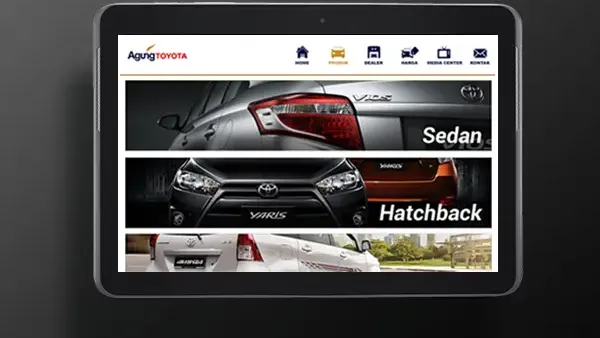
This meant giving customers direct access to model information, price comparison, credit estimation, test-drive reservations, maintenance bookings, and spare-parts reservations.
The approach recognized that customers may enter the journey at different points. Some may be researching cars, while others may already own a vehicle and need after-sales support.
2. Make vehicle research available at any time
The website gave customers 24/7 access to information about vehicle models and dealer services.
This extended Agung Toyota’s availability beyond showroom hours. Customers could research at a time that suited them, whether they were planning a purchase during the day or comparing options in the evening.
Always-available information also supported a less pressured decision process. Customers could explore independently before deciding when to contact the dealership.
3. Help customers compare vehicle prices
The website allowed users to research car models and compare prices.
Comparison was important because customers rarely evaluate one vehicle in isolation. They may weigh different models against their budget, household needs, and intended use.
Making the comparison process easier reduced the amount of work customers had to do across separate sources. It also helped Agung Toyota retain the customer’s attention within its own digital environment.
4. Use clear information to support model selection
Customers need more than a list of vehicle names. They need enough context to understand the differences between models and decide which ones deserve further consideration.
The website’s role was to make this early evaluation easier. Clear model information created a starting point for customers who were not yet ready to visit a showroom.
This also helped sales representatives later in the process. Customers arriving with a clearer shortlist could have more focused conversations at the dealership.
5. Add credit estimation to reduce financial uncertainty
The website included a credit estimation tool to help customers understand the possible credit amount and monthly payment.
This made financing part of the early research journey rather than a separate conversation that began only after model selection.
The feature supported planning. Customers could use an estimate to understand whether a vehicle was within reach and what questions they might want to ask the dealership.
6. Keep estimation useful without overstating certainty
A credit estimator should help users understand possibilities, but it should not be confused with a final financing approval.
The value of the feature came from giving customers an early reference point. It reduced uncertainty while leaving the formal approval process to the relevant financial and dealership teams.
This distinction protected trust. Customers received useful guidance without being given an unrealistic guarantee.
7. Make test-drive reservations more convenient
The website enabled customers to reserve a test drive online.
A test drive is an important moment in the vehicle decision process because it helps customers move from abstract research to direct experience. Making the reservation easier increased the chance that interested users would take that next step.
It also helped Agung Toyota manage demand more systematically. Customers could express their interest in advance rather than relying only on walk-in visits or manual arrangements.
8. Support vehicle maintenance reservations
The website also enabled customers to reserve maintenance services.
This extended the platform beyond acquisition and into ownership. Customers could use the same digital presence to manage an important part of keeping their vehicle in good condition.
For Agung Toyota, maintenance reservations created more continuity in the customer relationship. The dealership remained relevant after the purchase rather than becoming involved only when a new vehicle was being considered.
9. Add spare-parts reservations
Customers could reserve spare parts through the digital platform.
This addressed a practical ownership need. People may know what part they require but want confirmation of availability or a convenient way to arrange collection.
The feature improved planning and reduced the risk of a wasted visit. It also gave Agung Toyota another way to support customers through a direct digital channel.
10. Connect social media with the website
Agung Toyota’s social media profiles were connected to the website to create a more consolidated digital presence.
This allowed customers to move between official channels more easily. The website could serve as a structured information hub, while social platforms could support ongoing updates, engagement, and communication.
The connection also reinforced brand consistency. Customers could recognize that the different channels belonged to the same dealership organization.
11. Design the website as an extension of the showroom
A dealership provides several types of value: product guidance, comparison, financial explanation, test drives, service, and human support.
The website translated some of these functions into digital form. Customers could begin with research and continue toward a service or reservation without visiting a showroom for every step.
This did not eliminate the importance of salespeople. It gave them a better-prepared customer and a wider set of digital tools to support the relationship.
Designing the mobile app around direct, ongoing engagement
1. Put product and service information within reach
The mobile application made Agung Toyota’s information available directly on customers’ devices.
This was valuable because customers do not follow a fixed schedule when they think about cars, promotions, or service. They may have a question while traveling, comparing vehicles, or planning a maintenance visit.
Mobile access reduced the distance between the customer and the dealership. Information became available in the situations where the customer actually needed it.
2. Use push notifications to maintain timely communication
Push notifications gave Agung Toyota a direct way to communicate product and service updates.
Notifications could remind customers about relevant promotions, vehicle information, or service opportunities. This helped the dealership remain present without requiring customers to revisit the website manually.
The effectiveness of this channel depended on relevance and timing. Useful notifications could strengthen the relationship, while excessive or unrelated messages could create fatigue.
3. Extend the relationship beyond a transaction
The app gave Agung Toyota a way to remain connected with customers after they had researched or purchased a vehicle.
This supported a longer relationship that could include promotions, service reminders, product updates, and other relevant communications.
The app therefore complemented the website. The website supported deeper research and reservations, while the mobile app supported regular access and direct engagement.
4. Make the app relevant to different customer stages
A prospective customer might use the app to learn about a vehicle or promotion. An existing owner might use it to stay informed about service or dealership activities.
Designing for both groups increased the application’s usefulness across the customer lifecycle.
The dealership could communicate with future customers while continuing to support existing owners. This strengthened the relationship between acquisition and retention.
5. Use mobile to make the dealership feel closer
The central value of the app was proximity. Customers did not need to remember a website address or wait until they were near a showroom to connect with Agung Toyota.
A mobile app placed the dealership within the customer’s regular digital environment.
This helped express Agung Toyota’s objective of getting closer to customers. The relationship became easier to access and more continuous.
6. Support loyalty through practical value
Customer loyalty is strengthened when a brand remains useful after the initial purchase.
By providing product information, promotions, and service-related communication, the app created multiple reasons for customers to stay connected.
The goal was not to produce loyalty through messages alone. It was to earn continued attention by making the relationship more convenient.
7. Create a common digital standard across regions
Agung Toyota operated across Riau, Jambi, Bengkulu, the Riau Islands, and Bali.
A centralized website and app helped create a more consistent digital experience across these regions while still allowing the dealership to serve local customers.
This was valuable for a growing organization. Customers could encounter the same basic quality of information and service access regardless of where they interacted with Agung Toyota.
8. Build a platform that could evolve with the dealership
The digital presence created a foundation for future vehicle information, promotions, reservations, service features, and customer communications.
As Agung Toyota’s network and customer expectations changed, the platforms could continue to develop rather than remaining fixed at their original launch state.
The long-term value was greater digital readiness. The dealership gained a way to respond to customer behavior as it evolved.
A connected digital presence made dealership access more convenient
1. Customers gained 24/7 access to dealership information
The website allowed users to explore vehicle models, services, prices, and promotions outside traditional dealership hours.
This supported customers who preferred to research independently or needed information before deciding when to visit a dealer.
The website became a practical starting point for both new vehicle consideration and existing customer service needs.
2. Vehicle comparison became easier
Customers could review models and compare prices through one digital environment.
This reduced the need to gather information from multiple sources and helped users narrow their options more efficiently.
Better comparison also supported more focused conversations with sales representatives. Customers could approach the dealership with clearer questions and expectations.
3. Financing became easier to understand at an early stage
The credit estimation feature helped customers develop an initial view of credit amounts and monthly payments.
This gave them a more realistic basis for considering vehicles and planning their next step.
The tool supported better-prepared customers without replacing the formal financing process. It helped move financial questions earlier in the journey, where they could be addressed more constructively.
4. Test-drive reservations connected interest with experience
Online test-drive reservations made it easier for customers to move from browsing to direct product experience.
This was a meaningful conversion step. A customer who schedules a test drive has moved beyond general awareness and is actively considering a vehicle.
The digital reservation process reduced friction and created a clearer bridge between the website and the physical dealership.
5. Service reservations improved ownership convenience
Maintenance and spare-parts reservations gave existing customers more control over after-sales needs.
They could plan service-related activity through a digital channel rather than relying entirely on phone calls or visits.
This strengthened the ownership experience and helped Agung Toyota remain relevant throughout the vehicle lifecycle.
6. Social channels became part of one digital presence
Connecting official social media profiles with the website helped customers navigate between structured information and ongoing engagement.
This improved channel continuity. Customers could discover content through social platforms and move to the website for deeper information or reservations.
The combined presence also gave Agung Toyota more opportunities to remain visible across the customer journey.
7. The app created a direct communication channel
Push notifications allowed Agung Toyota to communicate with customers more directly.
The dealership could remind customers about relevant products and services when appropriate, while customers could receive updates without actively searching for them.
This strengthened the relationship between the brand and its customers. Communication could become more timely and useful rather than limited to occasional visits.
8. The dealership experience became more accessible across regions
The website and mobile app helped extend Agung Toyota’s service model beyond individual showroom locations.
Customers in different regions could access a more consistent set of information and functions, even though their physical dealership experiences might differ.
This supported Agung Toyota’s broader growth and helped the organization communicate as one trusted dealer network.
9. The platform created stronger conditions for customer loyalty
The digital ecosystem supported customers before purchase, during consideration, and after ownership.
This continuity created more opportunities for Agung Toyota to earn repeat engagement. Customers could return for information, promotions, reservations, or service-related needs.
The result was a more durable relationship than a single dealership visit could provide.
10. Agung Toyota gained a foundation for future digital services
The website and app established a base for future improvements in vehicle research, financing, service management, customer communication, and loyalty.
This reduced the need to treat each new customer expectation as a separate digital project.
The second-order effect was greater operational flexibility. Agung Toyota could continue adapting its dealership experience without abandoning the digital foundation already in place.
The deeper lesson: automotive retail begins long before the showroom
1. Customers need confidence before they need a salesperson
Customers often want to research models, prices, and financing independently before beginning a conversation with a dealer.
A digital platform that supports this early work can make the eventual salesperson interaction more useful and less repetitive.
2. Financing belongs early in the customer journey
Customers cannot evaluate a vehicle properly without understanding how it may fit their budget.
Credit estimation helps bring that consideration forward. It allows customers to explore affordability while they are still comparing models, rather than treating financing as a late-stage surprise.
3. After-sales services are part of the brand relationship
Maintenance and spare-parts reservations show that the dealership’s relationship does not end at vehicle purchase.
Digital convenience in after-sales care can strengthen loyalty because it affects the customer’s ongoing ownership experience.
4. A dealership app should earn its place on the phone
Customers will not remain engaged with an app simply because it exists. It must provide useful information, timely reminders, or convenient access to services.
The strongest mobile relationship is built through relevance. Notifications and features should help customers at moments that matter to them.
5. Digital and physical dealership experiences should reinforce each other
The website and app can support research, comparison, reservations, and communication, while the showroom provides human guidance and direct experience.
The goal is not to make one channel replace the other. It is to allow customers to move between them without unnecessary repetition or friction.
6. Regional consistency supports trust
A growing dealer network needs a consistent digital standard across locations. Customers should receive reliable information regardless of the region they come from.
Consistency does not mean every local experience must be identical. It means the basic quality and logic of access should remain dependable.
7. Digital engagement should continue after purchase
A customer who has bought a vehicle still needs maintenance, parts, updates, and support.
Continuing communication through a website and app helps the dealership remain useful throughout ownership. This supports loyalty through service, not only through promotions.
8. Convenience is a competitive differentiator
Many dealerships can offer similar products. The quality of the customer journey can become a meaningful point of difference.
When customers can research, estimate, book, and communicate easily, the dealership feels more responsive and modern. Convenience becomes part of the brand.
Strategic Insights for the C-Suite
- Design the dealership experience around the full ownership journey. Customers need support before purchase, during evaluation, and after ownership. Digital platforms should connect research, financing, reservations, maintenance, and communication.
- Move important questions earlier in the buying process. Model comparison and credit estimation help customers understand their options before they speak with a salesperson. Better-prepared customers create more productive commercial interactions.
- Use mobile engagement to remain useful after the sale. A dealership app should provide relevant information, reminders, promotions, and service access. Ongoing usefulness is more powerful than occasional promotional messages.
- Connect digital and physical channels without forcing a choice. Websites can support research and reservations, while showrooms provide human advice and direct experience. Customers should be able to move between them without starting again.
- Standardize the digital foundation across regional networks. Consistent access to vehicle, service, and dealer information strengthens trust while still allowing local teams to serve their communities effectively.