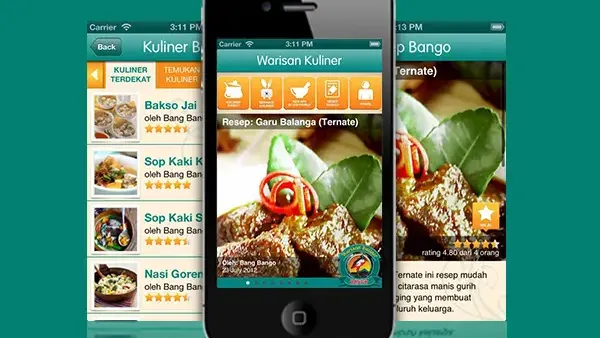

The Heritage Brand Facing Its Digital Inflection Point
Kecap Bango was already Indonesia's dominant soy sauce brand—decades of market leadership, deep consumer trust, and a clear strategic asset: a library of authentic Indonesian recipes that connected the product to real cooking rituals. But by 2011, Bango faced a paradox.
Their recipe content lived on wisatakuliner.com, a desktop-first property built for the web era. Meanwhile, smartphone adoption in Indonesia was accelerating rapidly. Modern home cooks—the demographic Bango needed most—were increasingly mobile-only.
The brand had the content. It lacked the distribution layer. Unilever Indonesia saw the gap and partnered with Suitmedia to build not just a recipe app, but a platform that would turn passive content consumers into active community contributors.
Why Simple Recipe Apps Miss the Real Opportunity
At first glance, the brief seemed straightforward: "Move recipes to mobile." But the real challenge was deeper and more interesting.
1. The accessibility problem was just the surface.
Bango's desktop recipe hub required a browser, login, and patience—friction that eliminated mobile-first users. But accessibility alone wouldn't build stickiness. Thousands of recipe apps existed by 2012, and the commoditized play (a searchable digital recipe book) would generate download traffic, then churn.
2. The engagement problem was existential.
Bango needed users to return repeatedly, to feel ownership, and ideally, to contribute their own recipes back into the ecosystem. This would signal authenticity and create network effects—each new contribution made the app more valuable for everyone else. Without this, the app was just a marketing expense.
3. The market timing window was closing fast.
Indonesia's smartphone penetration was crossing a critical threshold in 2011–2012. Device manufacturers were flooding the market: not just iPhone and Android, but BlackBerry, which still held 20%+ of the smartphone share. Competitors were beginning to move mobile. Bango had a 12–18-month window to own "trusted Indonesian culinary hub on mobile" before the category became crowded.
4. Multi-platform development added real complexity.
Supporting iOS, Android, and BlackBerry simultaneously multiplied development scope, testing, and maintenance burden. Most competitors would pick one or two platforms. Bango needed three to reach 80%+ of Indonesia's smartphone users. This was ambitious, but necessary.
5. Ecosystem integration introduced organizational friction.
The app couldn't exist in isolation. It had to connect to wisatakuliner.com (to avoid content duplication) and Facebook (to enable sharing and virality). Each integration point required technical coordination between Unilever's digital team and Suitmedia's execution. One broken sync, and the entire system would fragment.
Building a Platform, Not a Catalog
Suitmedia's approach rejected the "digital recipe book" mental model entirely. The team framed the app as a community platform with recipes as the connective tissue, not the endpoint.
4 Core Pillars That Anchored the Product Logic
1. Intelligent search and discovery.
Users could search by ingredient (recipes matching what's already in your kitchen), by category (breakfast, vegetables, meat), or by browse. This solved a real consumer problem—a home cook on mobile doesn't want to scroll through 500 recipes. They want to say, "I have shallots, garlic, and soy sauce—what can I make?" The algorithm had to be simple (mobile devices in 2012 had real constraints) but smart enough to deliver relevant results 90%+ of the time.
2. Contribution and curation by users.
The app allowed home cooks to upload their own recipes, rate existing ones, and comment. This wasn't a moderation problem—it was the retention engine. A user who uploads a recipe becomes a stakeholder. They'll return to see comments and upvotes on their contribution, and they'll browse other recipes while they're there. Bango's role shifted from "content publisher" to "platform curator."
The team built simple editorial workflows: new submissions went to a queue, Bango's culinary experts approved or polished them, and approved recipes appeared with the contributor's name. Attribution mattered. It incentivized sharing and signaled that Bango valued home cooks as equal partners in building the platform.
3. Social amplification built into every action.
Every recipe, rating, and comment could be shared to Facebook with one tap. In 2012, Facebook was Indonesia's primary social network—mobile-first, high engagement, family-oriented. Sharing recipes became a social signal: "I cook this. I trust Bango. My friends should know."
This created a viral loop. Friends see the recipe on Facebook, tap through to the app, discover more recipes, and contribute their own. The app didn't need expensive ads to grow; it grew through organic sharing and word-of-mouth amplification.
4. Venue discovery extended the platform beyond home cooking.
The app included a feature to find nearby restaurants and food vendors serving Indonesian cuisine. Users could rate venues, comment, and share recommendations. This expanded Bango's relevance beyond recipes into the broader Indonesian culinary lifestyle.
A home cook could use Bango recipes to cook at home, then use Bango's venue map to discover culinary experiences in their city. Two engagement loops, one app. This made the platform stickier because it solved multiple use cases in a single interface.
Technical Execution in a Fragmented Market
The technical architecture reflected market realities, not Silicon Valley defaults.
Suitmedia built natively for each platform.
iOS and Android used standard approaches. BlackBerry required a different codebase, but the underlying product logic remained consistent. This meant shared backend infrastructure, unified databases, and synchronized content—but separate native front-ends optimized for each OS's performance and constraints.
The team also built a lightweight web version for users on older devices or slow networks, ensuring the ecosystem remained accessible even at the edges of Indonesia's digital divide. This wasn't perfection across all platforms; it was strategic coverage across all user segments.
Integration with wisatakuliner.com avoided redundancy.
The website remained the SEO and editorial hub—longer-form content, food journalism, brand storytelling. The app was the discovery and social layer. New recipes uploaded via the app could be syndicated to the website (with user permission) and vice versa.
Users browsing the website could be nudged to download the app for personalized collections and social features. The two properties reinforced each other instead of competing, creating a coherent ecosystem where each channel had a clear role.
When Community Momentum Becomes Defensible Advantage
The app launched in 2012 and achieved traction that signaled genuine product-market fit—not explosive viral growth, but something more durable: organic user contributions and repeat engagement.
Contribution growth became the north star metric.
Within the first 6 months, home cooks were uploading recipes weekly, then daily. By 18 months, the app had accumulated thousands of user-submitted recipes—many hyperlocal variations on classic Indonesian dishes. A home cook in Surabaya might upload a Soto Ayam recipe passed down from her grandmother; a user in Bandung would rate it, comment that they added turmeric, and share it to their family group chat.
These contributions weren't curated by Bango's editorial team alone. They were crowdsourced, authentic, and proof that users saw the app as theirs, not as Bango's marketing vehicle.
Retention patterns showed the app had become habitual.
Users returned repeatedly to browse new recipes, check comments on their submissions, and share discoveries with friends. The app didn't suffer from typical churn (high download, rapid decline). Instead, engagement plateaued at a healthy level—a sign that the app had moved from "interesting experiment" to "habitual tool" in users' cooking lives.
This distinction matters. Many apps spike during launch, then fade. Habitual tools have lower peaks but much longer tails. They become infrastructure rather than novelty.
Social amplification created visible network effects.
Recipes shared to Facebook generated clicks back to the app. New users arrived via social referral, explored the app, and if they liked what they found, they'd contribute their own recipes or rate existing ones. This self-reinforcing cycle reduced Bango's dependency on paid acquisition and made growth economics favorable at scale.
Market position solidified around authentic differentiation.
By 2013, Bango had established itself as the mobile destination for Indonesian culinary discovery. Competitors were beginning to move into the space, but Bango's first-mover advantage—combined with the depth of user-generated content and the engaged community—created defensibility.
The app wasn't just a marketing asset. It had become a genuine utility that home cooks opened when they needed recipe ideas, ingredient matches, or community recommendations. That's a different thing entirely than a branded app that sits unused on someone's phone.
Venue discovery added a secondary engagement loop.
Users could rate and comment on local Indonesian restaurants and food vendors, turning the app into a crowdsourced food guide. This expanded Bango's relevance beyond home cooking into the broader Indonesian culinary ecosystem, creating more reasons for users to return and more valuable data about consumer preferences and regional trends.
3 Strategic Lessons From the Field
Building this app taught Suitmedia critical lessons about mobile-first product strategy in emerging markets.
1. Platform choice is a strategic decision, not just a technical one.
Supporting iOS, Android, and BlackBerry meant higher development cost and longer timelines. But it was the right trade-off. Bango reached 80%+ of Indonesia's smartphone users instead of 50–60%. Competitors who chose "iPhone first" or "Android only" missed entire segments.
In emerging markets with fragmented device adoption, coverage beats elegance. The lesson generalizes: when your market is still adopting smartphones (not saturated), multi-platform isn't luxury—it's a necessity.
2. User-generated content is a retention lever, not a content cost.
Bango could have hired culinary writers to build a massive recipe library. But user contributions created stickiness that paid content couldn't match. A home cook who sees her recipe commented on by thousands of other users will open the app weekly.
A home cook browsing someone else's published recipe will rate it, comment, and share it. This creates a network effect where the app becomes more valuable as more people contribute—not just consume. The cost structure also improves: content grows exponentially without proportional editorial overhead.
3. Community platforms need ecosystem integration to reach escape velocity.
The app couldn't live in isolation. It needed to connect to wisatakuliner.com (for SEO credibility), Facebook (for viral sharing), and Bango's broader brand presence. Each integration point required coordination, but it was essential.
A recipe app without social sharing is just another content tool. A recipe app tethered to your friends' recommendations and your favorite brand is a lifestyle platform. Integration doesn't just improve the product—it transforms the category it competes in.
Strategic Insights for the C-Suite
1. Timing beats perfection in emerging markets.
Bango moved first when smartphone adoption was accelerating but the competitive landscape was still sparse. A more polished app arriving 18 months later would have faced entrenched competitors and a saturated user base. In fast-moving markets, early, good-enough solutions often outcompete late, perfect ones. The window for category ownership is real and narrow.
2. User-generated content is the most durable retention lever.
Bango didn't try to own all recipe creation. It gave away control. Users became stakeholders, and stakeholders return repeatedly. This is harder than building a content library—it requires trust, moderation systems, and attribution frameworks—but the retention payoff is disproportionate. Community ownership beats corporate control for long-term stickiness.
3. Multi-platform coverage is a feature in fragmented markets.
Concentrating development on one platform misses the reality of emerging markets, where device adoption is fragmented. Strategic coverage of iOS, Android, and legacy platforms meant reaching the broadest addressable market. The additional development cost was worth the market share gain. This is different advice for saturated markets, but in Indonesia, India, Southeast Asia, and Africa, device fragmentation is the norm.
4. Integration creates network effects that isolated apps cannot.
The app's value multiplied because it connected to Facebook (for sharing), wisatakuliner.com (for SEO and syndication), and Bango's brand presence. A standalone recipe app would have been a novelty. An app embedded in a broader ecosystem became infrastructure. Think about your digital products as a system, not as standalone assets.
5. Authenticity and heritage are competitive moats in community platforms.
Bango's 50+ years of brand trust and genuine connection to Indonesian culinary traditions couldn't be replicated by a generic food app. By channeling user-generated content and positioning itself as a curator (not an inventor), Bango made the platform defensible. In community-driven products, authenticity and cultural alignment matter more than feature breadth.