Expanding a health app into a broader employee support platform
Astra Daihatsu Motor (ADM) is an automotive manufacturing company based in Jakarta and a joint venture between Daihatsu, Astra International, and Toyota Tsusho. Its employees work within a large operational environment where health, communication, and workplace coordination must function reliably.
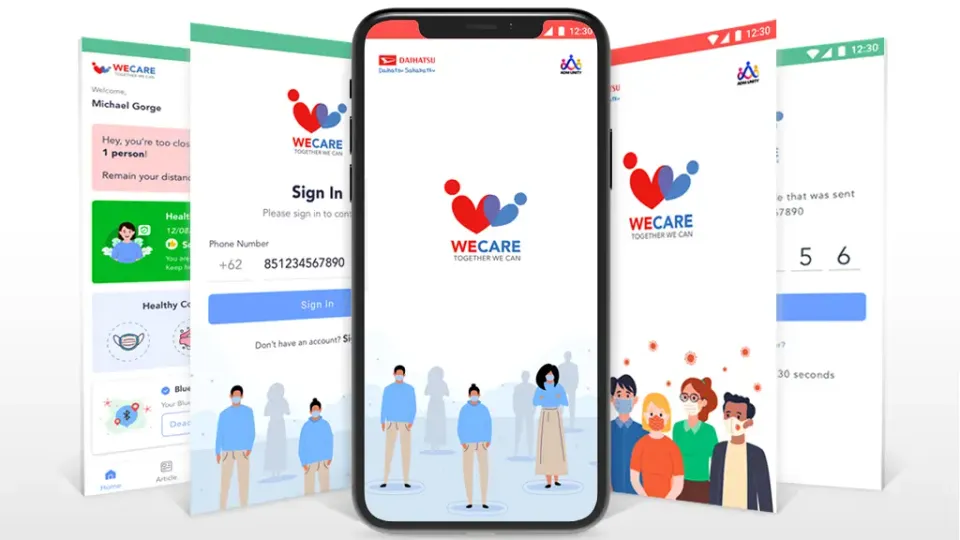
In 2020, ADM and Suitmedia developed WeCare to support physical distancing and contact-history tracking in the workplace. As the organization gained experience with the app, it identified an opportunity to make the platform more useful by bringing health, employee communication, surveys, and selected HR information into one application.
Suitmedia helped ADM upgrade WeCare through new features, database migration, access restrictions, homepage improvements, and a hybrid web-view approach. The result was a more complete employee platform that supported health assessments, distancing alerts, management communication, employee information, surveys, and direct messaging.
A focused health tool needed to support a wider employee reality
1. The original app had solved one urgent problem
WeCare was initially created to help ADM maintain physical distancing and track contact history in the workplace. This addressed an immediate operational need, but the organization’s requirements continued to develop.
As employees and management became familiar with the application, the platform presented an opportunity to support more than one health-related function. It could become a central place for employees to receive information, complete assessments, and communicate with the organization.
The challenge was to expand its usefulness without losing the clarity of its original purpose.
2. Employee needs were spread across different channels
Management needed ways to communicate important information to employees. Employees needed access to updates about absence, medical reimbursement, and overtime work. They also needed ways to ask questions and complete surveys.
If each need was managed through a different channel—email, messaging apps, documents, or separate systems—the employee experience could become fragmented.
ADM wanted one application that could bring these interactions closer together. The platform needed to support both information delivery and employee response.
3. Communication needed to work in both directions
One-way management communication is useful for distributing announcements, but it does not give employees a way to clarify or respond.
ADM wanted WeCare to support both broadcast communication and direct interaction. Management needed to send targeted information, while employees needed a direct route to ask questions or seek support.
This created a clear design requirement: the app had to distinguish between messages intended for broad distribution and conversations requiring a two-way exchange.
4. Not every feature should be available to every user
Because WeCare would include internal communication and employee information, ADM needed to control who could access specific features.
Some functions were intended only for employees, while others might be visible to non-employees or users with different roles. Without restrictions, sensitive information could be exposed to people who did not need it.
Access control therefore had to be part of the product design. The platform needed to remain easy to use while ensuring that the right users saw the right information.
5. ADM needed to connect health and HR information
WeCare was designed as a health-focused application, but ADM also wanted to integrate it with HRIS.
This connection could help employees access relevant workplace information through a familiar platform. However, it also increased the importance of data accuracy, access rules, and system compatibility.
The app needed to support the relationship between health, employee records, and workplace administration without turning into a confusing collection of unrelated features.
6. The database foundation needed to change
ADM used Microsoft SQL Server, or MsSQL, as its database management system, while the existing WeCare application used MySQL.
This created a technical need to migrate the database. The migration had to preserve important information while preparing the system for ADM’s preferred technology environment.
Database work is often invisible to employees, but it affects speed, reliability, and future development. A weak foundation could limit the value of the new features.
7. A native rebuild was not the only option
ADM wanted to add several new features, but budget considerations made a fully native redevelopment less suitable.
The organization needed a solution that could improve the user experience and expand functionality without creating unnecessary development cost.
Suitmedia recommended a hybrid web-view approach. This allowed ADM to deliver new capabilities through a mobile application while using web-based components where appropriate.
The decision reflected a practical balance between speed, cost, maintainability, and user access.
8. The platform had to remain useful after the immediate health crisis
Physical distancing and contact history were important use cases, but a platform built only for one period or one operational concern could quickly lose relevance.
ADM wanted WeCare to continue supporting employees as needs changed. Health assessments, surveys, employee information, and communication features gave the app a longer-term role.
This made the project an exercise in platform development, not only feature expansion.
Designing one employee experience for health, information, and communication
1. Begin with the needs of different internal audiences
Suitmedia first considered how ADM employees and management would use the upgraded application.
Employees needed access to health tools, information, surveys, and communication. Management needed a way to distribute announcements, respond to questions, and provide relevant updates.
Understanding these different needs helped define the features and their access rules. The app had to serve both sides of the organization without treating them as identical users.
2. Use a hybrid web-view approach to expand efficiently
Rather than rebuilding every feature as a native mobile function, Suitmedia recommended a hybrid approach using web-view components.
This allowed ADM to add new capabilities within the existing app while making better use of available budget. Web-based modules could be updated more flexibly, while the mobile application remained the primary access point for employees.
The decision also supported faster delivery. ADM could expand the platform without waiting for a complete native redevelopment cycle.
3. Preserve the value of the mobile entry point
Although some features used web-based components, employees still accessed them through the WeCare mobile application.
This helped keep the experience coherent. Employees did not need to learn a completely separate system for each new feature.
A single mobile entry point also strengthened adoption. The app remained the recognizable destination for health, communication, and employee information.
4. Create Broadcast Message for targeted management communication
The “Broadcast Message” feature allowed management to send one-way communications to employees, including attachments and messages directed to specific users.
This gave ADM a more controlled way to distribute announcements and information. Management could communicate through a central platform rather than relying on disconnected channels.
Targeted messaging was important because not every announcement applies to every employee. Sending information to the relevant audience reduces noise and makes important messages easier to notice.
5. Keep one-way communication clearly defined
Broadcast Message was designed as a distribution channel rather than an open conversation.
This distinction helped employees understand what the feature was for. They could receive official announcements and supporting documents without confusing the channel with a help desk or discussion thread.
Clear separation of communication types improves usability. Employees know where to look for official updates and where to go when they need to ask a question.
6. Add CS Hotline for two-way communication
The “CS Hotline” allowed employees to communicate directly with management through a messenger-style feature.
This addressed the limitation of one-way announcements. Employees could ask questions, clarify information, or raise concerns through a defined channel.
The feature also helped management understand employee needs more directly. Communication became a two-way relationship rather than a sequence of announcements with no clear response path.
7. Design communication features around trust
Internal communication systems can influence whether employees feel informed and supported.
A broadcast feature shows that management can communicate clearly. A hotline shows that employees have a place to seek answers or assistance.
Together, the features created a more balanced relationship. ADM could share information efficiently while remaining accessible to employees who needed clarification.
8. Introduce Employee Information as a central reference
The Employee Information feature acted as an information board for absence, medical reimbursement, and overtime work.
This brought practical employee information into the same environment as health features and communication tools.
A central reference reduced the need to search through multiple channels or ask HR for information that could be provided digitally. It also made WeCare more relevant to everyday employee administration.
9. Make workplace information easier to find
Employee information is most useful when it is structured and accessible at the moment employees need it.
By bringing absence, reimbursement, and overtime information into the application, ADM gave employees a clearer route to important workplace details.
This also supported HR and management. When employees can find information independently, HR teams may receive fewer repetitive requests and can focus on more complex support.
10. Create surveys as a direct feedback channel
Suitmedia added a survey feature that allowed ADM to distribute forms to employees.
Surveys could support health assessments, workplace feedback, or other information-gathering needs. The feature created a structured way for ADM to hear from its workforce.
Digital surveys also improved speed and consistency. Employees could respond through the application, while ADM could collect and manage the results more systematically than through paper or disconnected forms.
11. Connect surveys with the wider health mission
The survey function was not treated as a separate administrative feature. It supported WeCare’s broader role in employee health and workplace coordination.
ADM could use surveys to understand employee conditions, check awareness, or gather information related to health and safety.
This made the app more responsive. The organization could use employee input to improve decisions instead of relying only on assumptions or delayed reporting.
12. Retain physical distancing alerts and health assessments
The upgraded application continued to support the original health functions, including physical distancing alerts and health assessments.
This continuity was important. New communication and HR features expanded the app without removing the health capabilities that justified its original creation.
The result was a broader platform with a clear connection between employee health, workplace safety, and internal communication.
13. Migrate the database from MySQL to MsSQL
The project included a database migration from MySQL to Microsoft SQL Server.
This aligned the system with ADM’s preferred database environment and created a stronger technical foundation for future development.
Migration required careful handling of existing information. The objective was to improve compatibility and reliability without disrupting the employee experience or losing important records.
14. Adjust the homepage to reflect the expanded role
As WeCare gained more features, the homepage needed to help employees understand where to begin.
Suitmedia adjusted the layout so that health tools, communication, employee information, and surveys could remain accessible without making the interface feel crowded.
The homepage became a routing point for the broader platform. Employees could recognize the available services and choose the one relevant to their immediate need.
15. Manage access based on user type
The application included restrictions on features that could be accessed by non-employees.
This helped ADM protect internal information while keeping the public-facing or general features available where appropriate.
Role-based access also improved usability. Users were less likely to see features that did not apply to them, reducing confusion and supporting a more focused experience.
16. Keep the interface approachable for a broad workforce
Employees may have different levels of familiarity with digital tools. The application needed to make common actions easy to find and complete.
Clear labels, a focused homepage, and distinct communication functions helped reduce the amount of training required.
This was especially important because WeCare was intended to become an everyday internal platform. A system that requires frequent explanation will limit adoption and create additional work for support teams.
17. Test the expanded experience before broad use
Adding health, HR, communication, and survey features increased the number of ways employees could interact with WeCare.
The experience needed to be reviewed to ensure that the new features did not disrupt existing health functions or create confusing navigation.
Testing also helped verify that database migration, access restrictions, web-view modules, and mobile behavior worked together as intended.
18. Build for future employee services
The upgraded WeCare app created a structure that could support future internal services.
As ADM’s employees change, new information, communication, HR, health, or survey functions can be added to an existing platform.
This creates longer-term value. ADM can continue improving its employee experience without introducing a separate application for every new requirement.
WeCare became a more complete employee health and communication tool
1. Employees gained one place for several internal needs
The upgraded WeCare application combined health assessments, physical distancing alerts, survey forms, messaging, and employee information.
This made the platform more useful than the original health-focused app. Employees had more reasons to access it and could find several relevant services in one environment.
The result was a stronger internal digital touchpoint for ADM.
2. Management gained clearer communication channels
Broadcast Message gave management a structured way to share official information and attachments.
CS Hotline provided a separate channel for direct, two-way communication. Together, they helped ADM distinguish between formal announcements and conversations requiring response.
This improved the quality of internal communication. Employees could understand where to receive updates and where to seek support.
3. Employees could communicate with management more directly
The CS Hotline gave employees a defined route to contact management.
This reduced reliance on informal messaging channels and helped create a clearer record of employee questions and requests.
The feature also supported a more responsive culture. Employees were not limited to receiving information; they had a place to raise issues and ask for clarification.
4. Employee information became more accessible
The Employee Information feature brought absence, medical reimbursement, and overtime information into the app.
Employees could find relevant details more easily, while ADM gained a more consistent way to distribute internal information.
The centralization reduced the need to search through different documents or contact HR for routine questions.
5. Surveys became easier to distribute and complete
ADM could spread survey forms to employees through the application.
This made feedback collection more efficient and helped the organization reach employees through a channel they already used for health and workplace information.
Digital collection also improved consistency. Results could be managed more systematically and used to support future decisions.
6. Existing health features remained part of the experience
WeCare continued to provide health assessments and physical distancing alerts.
This preserved the app’s original purpose while expanding its role. The platform remained connected to employee well-being rather than becoming only an administrative HR tool.
The combination of health and communication features made the app more coherent as an employee support platform.
7. The database migration supported better performance and management
Migrating from MySQL to MsSQL created a more suitable foundation for ADM’s system environment.
The technical improvement supported data handling, reliability, and future development. It also helped the application manage a broader set of features without depending on an outdated foundation.
This was an example of invisible infrastructure creating visible user value.
8. The hybrid approach made expansion more practical
The web-view method allowed ADM to add features without the full cost and effort of rebuilding every function natively.
This helped the organization use its budget more effectively while still providing employees with access through a mobile application.
The result was a more efficient path to improvement. ADM could expand WeCare in stages rather than waiting for a large, high-cost redevelopment.
9. The platform became more useful for ongoing employee engagement
Because WeCare combined health, communication, information, and surveys, employees had reasons to return beyond a single health assessment.
This increased the possibility that the app would become part of everyday workplace behavior.
Regular use also helped ADM maintain a more direct connection with employees, especially when timely information or feedback was needed.
10. ADM strengthened its internal digital foundation
The upgraded app gave ADM a platform for managing employee health and workplace communication in one place.
It improved access for employees and created more structured processes for management and HR teams.
The second-order effect was greater organizational readiness. ADM could respond to future workplace requirements through an existing channel rather than starting a new implementation each time.
11. WeCare supported a more informed workforce
Health assessments, alerts, employee information, and surveys helped employees stay more aware of workplace conditions and organizational expectations.
This supported better participation in health and safety initiatives. Employees could receive information, respond to requests, and raise questions through the same environment.
The app therefore contributed to more than convenience. It supported a more connected and informed workforce.
12. The app became a platform for continued improvement
With new features and a stronger technical foundation, WeCare could evolve as ADM’s internal priorities changed.
Future development could build on the existing navigation, access model, communication channels, and database structure.
This reduced the risk of digital fragmentation. ADM gained a reusable platform rather than a collection of one-time features.
The deeper lesson: employee apps should connect health, information, and voice
1. A health app can become a wider employee support system
WeCare began with physical distancing and contact-history tracking. Its expansion showed that a focused app can grow into a broader platform when new features remain connected to employee needs.
Health, HR information, communication, and surveys can reinforce one another when organized clearly.
2. One-way and two-way communication serve different purposes
Broadcasts are efficient for official information. Direct messaging is better for questions, clarification, and support.
Keeping these functions distinct helps employees understand how to use each channel and helps management handle communication more effectively.
3. Internal information should be accessible without repeated requests
Employees should not need to contact HR every time they need basic information about absence, reimbursement, or overtime.
A well-organized employee platform gives people more independence while reducing repetitive administrative work.
4. Hybrid development can balance budget and experience
Native development is not always the only path to a useful mobile application. A hybrid web-view approach can allow organizations to expand functionality more efficiently when budget and time are important constraints.
The decision should be based on user needs, security, performance, and long-term maintainability.
5. Database decisions shape employee experience
Employees may never see the database, but they experience its effects through speed, availability, and reliability.
Migrating to a more suitable database environment can support a better experience as the platform grows.
6. Feedback tools make communication more complete
Surveys give employees a structured way to contribute information rather than only receive messages.
When organizations listen through the same platform they use to communicate, they can respond more quickly and make decisions based on current employee input.
7. Access control must be designed into the experience
Internal information requires protection, but security should not make the platform difficult for authorized users.
Role-based access can protect sensitive features while keeping the interface focused and understandable for each user group.
8. A platform’s value grows when employees return regularly
The strongest employee apps provide recurring utility. Health assessments, information boards, surveys, alerts, and messaging create different reasons to return.
Repeated usefulness helps the platform become part of workplace culture rather than remaining a one-time initiative.
Strategic Insights for the C-Suite
- Expand internal platforms around connected employee needs. Health, communication, HR information, and feedback can share one environment when the experience remains clear. Consolidation increases usefulness and adoption.
- Separate broadcast communication from employee dialogue. One-way announcements and two-way support serve different purposes. Designing both deliberately improves clarity, responsiveness, and trust.
- Use hybrid technology when it protects value and speed. A web-view approach can extend a mobile platform efficiently when native redevelopment is not justified. Evaluate technology by user outcomes and long-term maintainability.
- Make employee information self-service where appropriate. Easy access to absence, reimbursement, overtime, and survey functions reduces repetitive HR work and gives employees more control over routine tasks.
- Treat employee feedback as operational data. Surveys and direct communication reveal workforce needs in real time. Use that information to improve policy, communication, health programs, and workplace decisions.