
Giving patients a simpler way to manage appointments and care
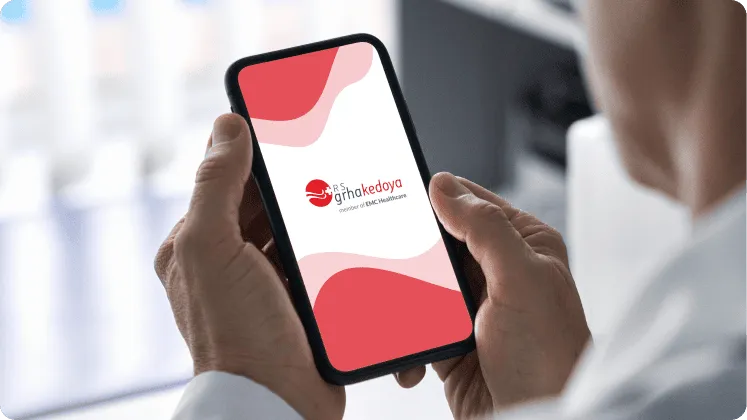
Grha Kedoya Hospital, part of the EMTEK Group, wanted to improve how patients accessed its services through mobile devices. The hospital had already worked with Suitmedia on its website, but the mobile application still had limitations in both appearance and functionality.
Patients found it difficult to make online appointments, access doctor schedules, and use other digital healthcare services. Grha Kedoya also wanted the application to support telehealth, laboratory services, and broader health access features, building on capabilities developed for the EMC Hospital mobile app.
Suitmedia redeveloped the application to create a more modern, secure, and user-friendly patient experience. The result was a mobile platform that made online appointment booking easier while creating a foundation for broader digital healthcare access.
The mobile app was not yet matching patient expectations
1. Patients were increasingly managing healthcare through their phones
Mobile devices have become a natural starting point for many everyday services, including healthcare. Patients expect to be able to search for doctors, check availability, and make appointments without needing to call or visit a hospital first.
For Grha Kedoya, this created a clear opportunity. A mobile application could give patients more control over when and how they arranged care, especially when they were unable to contact the hospital during working hours.
However, convenience depends on execution. If the application is difficult to understand or unreliable, patients may return to manual channels or postpone taking the next step.
2. The existing application created friction at a critical moment
The application’s appearance and functionality were not yet sufficient to support a smooth appointment journey. Users encountered difficulties when trying to book appointments online.
This created friction at the moment when the patient had already shown intent. They may have found the hospital or a doctor they wanted to see, but the digital experience made it harder to complete the action.
In healthcare, this can have broader consequences. A difficult booking process may increase calls to hospital staff, create uncertainty about whether an appointment was recorded, or cause patients to consider another provider.
3. Doctor schedules needed to be easier to access
Online booking is only useful when patients can see which doctors are available and when they can be visited.
If schedule information is unclear, outdated, or disconnected from the booking flow, patients may need to contact the hospital for confirmation. This adds work for both the patient and the hospital team.
Grha Kedoya needed a mobile experience that connected doctor discovery, schedule review, and appointment booking into one clear journey.
4. The application needed to support more than appointments
The hospital wanted to introduce additional services, including telehealth, laboratory tests, and health access features.
This expanded the role of the application. It was no longer intended to be only a booking tool. It needed to become a broader gateway to healthcare services.
The challenge was to add capability without creating a crowded or confusing interface. Users should be able to find the service they need without having to understand the full structure of the hospital’s digital system.
5. Healthcare users need confidence in the digital process
Patients provide personal information when making appointments and using healthcare services. They need to feel that the application is secure and that their requests will be handled correctly.
An outdated interface can weaken this confidence. Users may question whether the appointment has been submitted, whether the schedule is current, or whether their information has been recorded safely.
The redesigned application needed to communicate reliability through both its visual design and its behavior.
6. The patient experience had to work for different levels of urgency
Some users may open the app with a specific doctor or appointment in mind. Others may be exploring telehealth, laboratory services, or general health access for the first time.
These patients need different levels of guidance. A returning user wants speed, while a first-time user may need explanation before taking action.
The app needed to support both behaviors without making the main experience complicated.
7. Grha Kedoya wanted to build on proven digital capabilities
The hospital wanted the mobile application to incorporate features available in the EMC Hospital mobile app, another Suitmedia project within the EMTEK Group.
This provided a valuable reference point. Grha Kedoya could build on patterns that had already been developed for healthcare use rather than starting from an entirely untested model.
At the same time, the experience needed to reflect Grha Kedoya’s own patients, services, and operational context. Reuse had to improve consistency without becoming a rigid copy.
8. The hospital needed a stronger digital relationship with patients
The mobile application was part of a wider effort to make healthcare access more convenient and modern.
A successful app could help Grha Kedoya remain connected to patients between visits. It could become a practical place to manage appointments, explore services, and access future digital care features.
The immediate challenge was appointment booking, but the strategic opportunity was to create a more durable patient relationship.
Redeveloping the application around the patient’s next action
1. Start with the patient journey, not the feature list
Suitmedia approached the redevelopment by considering what patients needed to accomplish through the application.
The core journey began with discovering a doctor or service, reviewing availability, and booking an appointment. Additional services such as telehealth, laboratory tests, and health access needed to fit around this central path.
This helped prevent the application from becoming a collection of disconnected features. Each function had to have a clear role in helping patients access care.
2. Refresh the application’s visual experience
The application’s overall appearance was redesigned to create a more modern and approachable experience.
A visual refresh was important because the interface is part of how patients evaluate the hospital. A clear and contemporary design can signal that the organization is attentive to convenience and prepared to deliver modern services.
The design also needed to support quick recognition. Patients should be able to identify appointment booking, doctor schedules, telehealth, and laboratory services without searching through dense menus.
3. Simplify online appointment booking
The new application made it easier for users to book appointments online.
The booking experience was structured to reduce unnecessary steps and make progress clear. Patients needed to understand what information was required, which doctor and schedule they had selected, and what would happen after submission.
A simpler flow helped patients complete the task independently. It also reduced the likelihood that they would abandon the process or switch to phone-based support.
4. Connect doctors, schedules, and booking
Doctor schedule access was integrated into the patient journey.
This allowed users to evaluate availability before booking and reduced the need to move between separate areas of the application. The connection made the process more logical from the patient’s perspective.
A patient does not think of a doctor profile and a schedule as separate systems. They are two parts of one decision: whether and when to make an appointment.
5. Design for secure and dependable transactions
The application was redeveloped to support secure online appointment booking.
Security needed to be present without creating unnecessary complexity. Patients should be able to trust the system while still moving through the process easily.
This balance is essential in healthcare. A secure experience that is too difficult may discourage use, while a simple experience that does not communicate confidence may create concern.
6. Introduce telehealth as part of the same access model
Telehealth features gave patients another way to connect with healthcare professionals.
Including telehealth within the same application helped patients view remote care as part of Grha Kedoya’s broader service offering rather than as a separate channel.
This also increased flexibility. Patients could consider whether an in-person visit or a remote consultation was more appropriate for their situation.
7. Add laboratory test access
Laboratory-related features expanded the app’s usefulness beyond doctor appointments.
Patients could access information connected to laboratory services within the same digital environment. This reduced the need to manage separate channels for related healthcare activities.
The feature also supported continuity. A patient’s relationship with the hospital could include consultation, testing, and follow-up rather than ending at the appointment request.
8. Create a broader health access experience
The health access features were intended to make the application a more complete gateway to Grha Kedoya’s services.
This required careful prioritization. Users should be able to identify the service they need without facing an overwhelming list of options.
A focused structure allowed the app to expand its role while maintaining usability. The platform could support more services without losing the clarity required for quick appointment actions.
9. Use familiar patterns from the EMC mobile app
The application incorporated features from the EMC Hospital mobile app, previously developed by Suitmedia.
This approach helped Grha Kedoya benefit from established healthcare experience and reduced the need to invent every interaction from the beginning.
Shared patterns can also reduce user learning effort across related hospital platforms. When key functions behave in familiar ways, patients can adapt more quickly.
10. Adapt the solution to Grha Kedoya’s context
Although the project used the EMC app as a reference, Suitmedia still needed to understand Grha Kedoya’s specific requirements.
A healthcare application must reflect the services, schedules, workflows, and patient expectations of the hospital using it. Direct replication could create gaps if the operating context differed.
The redevelopment therefore combined proven design principles with implementation decisions suited to Grha Kedoya.
11. Make the application easier to use repeatedly
The app needed to work for both first-time and returning users.
Returning patients should be able to access appointments and services quickly, while new users should receive enough guidance to understand where to begin.
This supported adoption over time. A mobile healthcare app becomes valuable when it is easy enough to use repeatedly, not only when a patient first downloads it.
12. Design the platform for future healthcare services
The redevelopment created a stronger base for additional digital services.
As Grha Kedoya’s digital strategy develops, the application can potentially support new appointment types, reminders, patient information, payment services, and follow-up features.
This made the project more than a correction to an existing app. It created a foundation for continued improvement in patient access.
13. Test the experience against real patient expectations
A healthcare application should be evaluated through practical use, not only internal approval.
The experience needed to be clear when users were searching for a doctor, checking a schedule, booking an appointment, or exploring a new service. Testing these journeys helps reveal where users hesitate or misunderstand the interface.
This is particularly important in healthcare, where users may be stressed or short on time. A design that seems simple internally may still require refinement when used by patients.
14. Treat the app as part of the hospital’s service promise
Grha Kedoya’s digital application was intended to communicate convenience, accessibility, and modern care.
That promise needed to appear in the full experience: visual design, speed, navigation, booking, and access to services.
When the application consistently reduces effort, it provides practical evidence that the hospital is committed to improving how patients interact with it.
Patients gained a more convenient route to appointments and care
1. Online appointment booking became easier to use
The enhanced application made it simpler for patients to schedule appointments with doctors.
This reduced the need to rely on phone calls or physical visits for a routine task. Patients could begin the process through their mobile devices and manage it more conveniently.
The improvement addressed the main challenge directly: making healthcare appointments more accessible through a digital channel.
2. Patients received a more modern mobile experience
The redesigned interface gave Grha Kedoya a stronger mobile presence.
A contemporary and organized experience helped the hospital appear more responsive to changing patient expectations. It also made the app easier to understand for users who were accustomed to modern consumer applications.
This strengthened the connection between the hospital’s service ambition and the experience patients actually received.
3. Doctor schedules became part of a clearer decision path
Patients could access doctor schedules as part of the appointment journey.
This allowed them to make more informed decisions and reduced unnecessary back-and-forth with hospital staff.
The result was greater control for patients and a more structured process for the hospital.
4. Telehealth expanded access options
The inclusion of telehealth gave patients an alternative way to engage with healthcare professionals.
This supported patients who might face travel constraints, scheduling difficulties, or a need for an initial remote consultation.
It also positioned Grha Kedoya as a provider that could support different modes of care within one digital ecosystem.
5. Laboratory services became easier to access digitally
Laboratory test features helped connect another part of the patient journey to the application.
This reduced fragmentation and gave patients a more complete view of available services. They could use one platform to manage more of their interactions with the hospital.
The broader effect was greater continuity. Patients did not need to treat appointments, consultations, and laboratory services as entirely separate experiences.
6. The app became more useful beyond a single booking
By combining appointments with telehealth, laboratory tests, and health access features, the application gained more reasons for patients to return.
This supported a longer relationship between Grha Kedoya and its patients. The app could remain relevant between visits rather than being opened only when someone needed to schedule an appointment.
Repeat usefulness is important for adoption. The more regularly patients benefit from the platform, the more natural it becomes to use it for future care.
7. The hospital improved its digital service capacity
The enhanced mobile application gave Grha Kedoya a more capable channel for delivering patient services.
The hospital could support more digital interactions without requiring every request to begin through manual staff contact.
This created operational capacity while preserving the option for human assistance when patients had more complex needs.
8. Patients responded positively to the new experience
The case study reports favorable responses and broad acceptance of online appointment booking.
This indicates that the enhancements matched a real patient preference. Users were willing to rely on the mobile application to arrange care when the process became easier and more understandable.
Acceptance is an important outcome because healthcare technology creates value only when patients trust and use it.
9. The hospital strengthened its position as a modern provider
The application helped Grha Kedoya demonstrate its commitment to convenience, accessibility, and digital healthcare services.
This supported the hospital’s wider reputation. Patients could see that the organization was investing in ways to make care easier to reach.
The result was not only improved appointment access, but a stronger digital expression of the hospital brand.
10. The platform created a foundation for future patient engagement
The mobile app can support future features that deepen the relationship with patients.
These may include appointment reminders, digital records, payments, health education, laboratory results, and more connected follow-up services.
The current work created the foundation for that evolution. Grha Kedoya now has a stronger platform from which to expand its digital healthcare offering.
The deeper lesson: mobile healthcare succeeds when it makes care easier to begin
1. Convenience is a patient outcome
Patients do not experience convenience as a technical feature. They experience it as less waiting, fewer phone calls, clearer choices, and more control over the care process.
The application created value by reducing these forms of effort. Its success should be judged by how much easier it makes the patient’s next step.
2. Appointment booking is the start of a relationship
A booking system should not be treated as an isolated transaction. It is the beginning of a wider relationship involving consultation, testing, payment, follow-up, and future care.
Building additional services into the same app creates continuity and reduces the need for patients to learn separate systems.
3. New features should follow the patient’s real journey
Telehealth, laboratory access, and health services are valuable when they connect to actual patient needs.
Features should not be added simply because they are technically possible. They should help patients move through care with less uncertainty and fewer disconnected steps.
4. Reusable patterns can accelerate healthcare innovation
Building on the EMC mobile app allowed Grha Kedoya to benefit from prior healthcare experience and established design thinking.
Reuse can improve speed and consistency, provided the solution remains adapted to the hospital’s specific operations and patient population.
5. Digital access should expand choice without increasing complexity
Adding more services can make an app more valuable, but only if users can still understand where to go.
The platform must make the most common actions obvious while allowing users to discover additional capabilities when relevant.
6. Adoption depends on trust as much as functionality
Patients will use an app for healthcare when they believe it is secure, reliable, and worth the effort.
A modern interface helps, but trust is built through the complete experience: accurate schedules, clear confirmation, dependable performance, and useful services after booking.
7. The best healthcare apps reduce dependence on avoidable support
Digital self-service should not eliminate human care. It should reduce the need for staff to handle routine tasks that patients can complete confidently themselves.
This allows hospital teams to focus their attention on more complex requests and more personal forms of support.
Strategic Insights for the C-Suite
- Make mobile access a direct extension of the patient experience. Patients should be able to find doctors, check availability, and arrange care without unnecessary calls or visits. Convenience is part of service quality.
- Connect appointment booking with the wider care journey. Telehealth, laboratory services, health access, and future follow-up features create more value when they exist within one connected platform.
- Add features only when they reduce patient effort. A broader app is not automatically a better app. Every new capability should make care easier to discover, understand, or manage.
- Use proven healthcare patterns while adapting to local needs. Reusing successful foundations can accelerate delivery and improve consistency. The design must still reflect each hospital’s workflows and patient expectations.
- Build trust into every mobile interaction. Secure booking, current schedules, clear confirmations, and dependable performance determine whether patients will continue using the application. Functionality earns adoption; reliability sustains it.