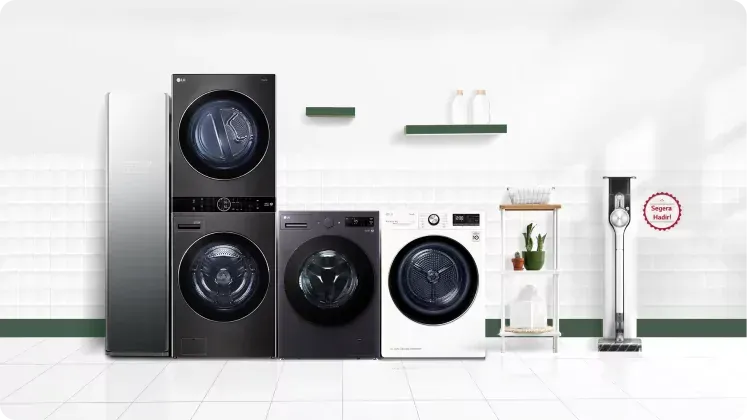

LG Electronics has spent decades turning complex technology into products people can use in everyday life. Founded in 1958 and headquartered in Seoul, the company operates across major categories including home entertainment, home appliances and air solutions, and vehicle components.
That breadth is a strength, but it can also make product selection more difficult. Customers looking for a refrigerator, washing machine, kitchen appliance, or other home solution may face many models with different features, sizes, capacities, and price points.
LG’s existing website did not provide a dedicated experience for customers who wanted personalized product guidance. Suitmedia partnered with LG between 2024 and 2025 to create the LG Home Appliances Product Selector—a responsive microsite that asked users a series of simple questions and recommended products based on their answers.
The goal was not to show customers more products. It was to help them find a relevant product with less effort and greater confidence.
A Broad Product Portfolio Was Creating Choice Without Enough Guidance
1. More options made the decision harder
LG offers home appliances for different spaces, lifestyles, household sizes, and priorities. A customer may be choosing between products that appear similar but differ in capacity, functions, energy use, dimensions, or intended use.
For an informed shopper, this range can be useful. For someone who is not familiar with appliance specifications, it can create uncertainty.
Customers may not know which features matter most or how to translate their household needs into a product model. They may start with a practical question—“Which washing machine is right for my family?”—but find themselves navigating technical product pages instead of receiving a direct answer.
The challenge was to make LG’s product range easier to understand without removing the depth needed for a considered purchase.
2. The existing website was organized around products, not customer needs
A conventional product website usually asks visitors to browse categories, apply filters, and compare individual models.
This works when customers already know what they want. It is less effective when they are still defining their needs.
A user may know that they need a refrigerator but not know which capacity, configuration, or feature set fits their household. They may also be uncertain about the terms used to describe different products.
Without guidance, the burden of decision-making remains with the customer. They must interpret the product range, identify the relevant differences, and decide which specifications matter.
LG needed to create a path for users who were interested but not yet product experts.
3. Poor guidance can affect both satisfaction and commercial performance
When customers struggle to choose, several outcomes are possible. They may leave the website, delay the purchase, select a product that does not fit their needs, or seek advice from a competitor.
Each outcome creates a cost.
A difficult decision journey can reduce engagement before a customer reaches a product detail page. It can also weaken confidence in the brand, even when the underlying product portfolio is strong.
For LG, the opportunity was to make the digital experience part of the value proposition. If the platform helped customers make a better decision, it could strengthen trust in both the recommendation and the brand behind it.
4. The experience needed to serve different types of shoppers
Not every customer approaches an appliance purchase in the same way.
Some users may care about kitchen functionality. Others may prioritize laundry capacity, space constraints, family needs, appearance, or specific features.
A fixed recommendation would not work for all users. The system needed to capture differences in preference and use them to narrow the product set.
At the same time, the interaction could not become a long or complicated survey. Customers needed to feel that answering questions was easier than browsing every product page individually.
5. Personalization had to remain connected to reliable product information
A recommendation is only useful if customers can understand why it was made and what to do next.
The microsite needed to present relevant product models and connect each recommendation to the corresponding product page on lg.com/id.
This ensured that the product selector acted as a guided entry point rather than a separate product destination. Customers could receive a recommendation, review more detailed information, and continue toward consideration or purchase through LG’s main website.
The challenge was to create a personalized experience without isolating users from LG’s broader digital ecosystem.
Turning Product Selection Into a Guided Conversation
1. We designed around the customer’s decision, not the product database
Suitmedia began with a user-focused approach to the product selection problem.
The central question was not “How can we display all LG products?” It was “What does a customer need to tell us before we can recommend a relevant product?”
This changed the structure of the experience. Rather than presenting a large catalog first, the microsite invited users to answer a series of multiple-choice questions.
Each response helped narrow the possible recommendations. The interaction became a guided conversation: the customer described their needs, and the platform translated those needs into product suggestions.
This reduced the cognitive load associated with browsing a broad product range.
2. We used a questionnaire to make product discovery approachable
The microsite led users through a sequence of questions with multiple-choice answers.
Question-based interaction was chosen because it uses everyday language more naturally than technical filtering. A customer may find it easier to answer a question about household needs or usage patterns than to select an unfamiliar specification.
The questions also helped break the decision into smaller steps. Instead of asking users to evaluate every feature at once, the platform gradually collected the information needed to narrow the options.
This made the experience more accessible to customers at different levels of product knowledge.
3. We translated answers into tailored recommendations
The system used users’ answers to filter the available product options and present recommendations.
The purpose was not to claim that one recommendation would be perfect for every customer. It was to reduce the search space and give users a more relevant starting point.
For example, a user’s responses could help guide them toward a category or model better aligned with their household requirements, priorities, or usage patterns.
This helped move the customer from an open-ended search to a focused set of possibilities.
4. We linked recommendations directly to LG product pages
Each recommended product was connected to its corresponding page on lg.com/id.
This decision preserved the role of LG’s main website as the source for deeper product information. The microsite helped customers discover relevant models, while the main product pages could provide specifications, imagery, features, availability, and other details.
The link between the two platforms created a more complete journey:
- The user answers questions.
- The microsite suggests relevant products.
- The user selects a recommended model.
- The user continues to the product page on LG’s main website.
- The user evaluates the product in greater detail.
This prevented the microsite from becoming a disconnected campaign tool. It became an entry point into LG’s broader digital commerce and product ecosystem.
5. We prioritized clear interface design over unnecessary complexity
The product selector needed to feel easy from the first interaction.
Suitmedia designed a clear and intuitive user interface so that users could understand the question, choose an answer, and move forward without confusion.
The visual design supported the decision process rather than competing with it. Controls were made recognizable, the sequence was easy to follow, and the recommendation stage was presented as a natural result of the user’s input.
This was important because guided selling can become frustrating if the questionnaire feels like a long form. The interface needed to communicate progress and reward users with a useful result.
6. We made the experience responsive across devices
Customers may research appliances from desktops, tablets, or mobile phones. The microsite was therefore designed to work across different screen sizes.
Responsive design ensured that the questionnaire remained usable on smaller screens and that recommendations could be reviewed comfortably regardless of the device.
This supported a broader range of customer behavior. A user could begin exploring the selector on a mobile device and continue reviewing recommended products later on a desktop.
The experience was designed to remain consistent across these contexts so that device changes did not interrupt the decision journey.
7. We used interaction to increase engagement, not just decoration
The microsite’s interactive structure made product selection more active than conventional browsing.
Users had a role in shaping the experience. Each answer influenced what they saw next and contributed to the final recommendation.
This created a stronger sense of involvement. Customers were not simply being shown products; they were participating in a process designed around their needs.
The interaction also created an opportunity for LG to communicate in a more helpful tone. The brand could guide users through a choice rather than asking them to interpret a large set of product pages alone.
8. We balanced personalization with customer control
A recommendation system can be useful, but customers still need the ability to evaluate the result for themselves.
The microsite therefore directed users to detailed product pages rather than treating the recommendation as the final answer.
This preserved customer control. Users could review the recommended product, compare it with other options, and make their own decision based on the information available.
The platform’s role was to reduce effort and improve relevance—not to replace customer judgment.
9. We optimized the platform for operational reliability
The project included periodic updates, maintenance, troubleshooting, and performance optimization.
This was important because product selectors depend on current product information and stable interaction flows. If a recommendation links to an outdated page or the questionnaire stops working, user trust declines quickly.
Ongoing support helped keep the microsite reliable and aligned with LG’s product ecosystem.
It also reduced the operational burden of responding to issues after launch. Stability was treated as part of the customer experience rather than as a separate technical concern.
10. We used the microsite to strengthen the wider LG brand experience
The product selector was designed not only to improve product discovery, but also to reinforce LG’s customer-focused positioning.
A company can communicate that it understands customers through advertising. It demonstrates that understanding more convincingly when its digital tools help people make decisions.
The microsite made LG’s broad product range feel more approachable. It showed that the brand could meet customers at the beginning of the decision process, when they were still trying to understand what they needed.
From Product Overload to More Confident Discovery
1. Customers could find relevant products with fewer steps
The microsite reduced the need for users to browse through multiple product categories before identifying suitable models.
By answering a sequence of focused questions, users could reach recommendations more directly.
This improved efficiency for customers who wanted help rather than a complete catalog. They could spend less time interpreting product structures and more time evaluating products that appeared relevant.
2. Personalization made the experience more useful
The recommendations were based on each user’s responses rather than presented as the same list to everyone.
This helped the platform feel more relevant and made the product range easier to navigate.
Personalization also supported trust. When users see that a recommendation reflects the information they provided, the result feels more considered than a generic promotion.
3. The platform connected guidance with detailed evaluation
The recommendation stage did not end the customer journey. Links to LG product pages allowed users to continue into more complete product information.
This created an appropriate division of roles. The microsite simplified discovery, while LG’s main website supported deeper evaluation.
The combination gave users both convenience and control.
4. The interface made product selection more engaging
The questionnaire-based structure transformed product discovery into an active interaction.
Users could see their answers contribute to the result, which made the process more engaging than scrolling through a conventional product list.
This helped reduce the emotional distance between the customer and the product range. Instead of feeling like an outsider trying to decode technical information, the user was guided through a process built around their own needs.
5. The microsite strengthened LG’s customer-focused image
The platform demonstrated LG’s focus on helping customers choose more effectively.
The brand was not only presenting products. It was providing a tool that reduced uncertainty and made the selection process easier.
This supported a stronger digital brand experience and gave LG a practical way to express customer focus through interaction.
6. Ongoing maintenance protected the quality of the experience
Suitmedia’s continued optimization, reporting, troubleshooting, and technical support helped keep the platform stable.
This allowed LG to maintain the experience over time rather than treating the microsite as a one-time launch asset.
The second-order effect was operational confidence. LG’s teams had a more reliable platform that could continue supporting product discovery as offerings and customer expectations changed.
7. The project improved efficiency for both users and internal teams
For customers, the product selector reduced search effort. For LG, it created a more structured way to guide customers toward relevant categories and models.
This could also reduce repeated questions about which product might suit a specific need, particularly when the questionnaire addressed common decision factors.
The platform did not eliminate the need for customer support or expert advice. It helped handle the early stage of product discovery more efficiently.
What the LG Product Selector Reveals About Guided Selling
1. Personalization is most valuable when it reduces uncertainty
Personalization should not be added simply because it sounds advanced.
In the LG Product Selector, its value came from helping customers narrow a large product range and reach relevant options faster.
The strongest personalization answers a real customer problem. Here, the problem was not a lack of products; it was uncertainty about which product to choose.
2. Guided selling is useful before a customer knows the product language
Customers often understand their needs in everyday terms rather than technical specifications.
A questionnaire can translate those everyday needs into product recommendations, making the decision process more accessible.
This is particularly useful for categories where products appear similar but differ in technical ways that customers may not immediately understand.
3. Recommendations should lead to evidence
A recommendation alone can feel arbitrary if users cannot explore the reasoning or inspect the product in detail.
Linking each recommendation to the relevant product page gave customers a path to verify and evaluate the result.
The broader principle is to combine guidance with transparency. Help users narrow their choices, then give them the information needed to make their own decision.
4. A microsite can solve a specific journey problem without replacing the main website
The LG Product Selector did not need to duplicate the entire LG website.
Its role was narrower and more focused: help users identify relevant products. The main website remained responsible for detailed product information and the next stages of evaluation.
This separation made the overall digital ecosystem more effective. Each platform had a clear job.
5. Interactive experiences require ongoing ownership
A product selector can become unreliable if product data, links, or logic are not maintained.
Regular updates and troubleshooting are therefore part of the product experience, not optional aftercare.
Interactive digital tools create lasting value when they are treated as operating systems that require ownership, measurement, and improvement.
6. Customer experience can be a competitive advantage in crowded categories
Home appliances are often compared through price, specifications, and promotions.
A guided selection experience creates another basis for differentiation: helping customers choose with less confusion and more confidence.
When competitors offer similar products, the company that makes the decision easier can earn greater trust and stronger consideration.
Strategic Insights for the C-Suite
- Use guided selling when product choice creates uncertainty.
If customers struggle to translate their needs into product specifications, a question-based experience can reduce confusion and direct them toward more relevant options. - Personalization should simplify decisions, not add complexity.
The value of personalization is measured by the effort it removes. Use customer inputs to narrow choices and make recommendations more useful. - Connect recommendations to transparent evidence.
A recommendation should lead to detailed product information so customers can evaluate the result for themselves. Guidance earns trust when it supports—not replaces—customer judgment. - Give each digital platform a clear role.
A focused microsite does not need to duplicate the main website. It can improve one important stage of the customer journey and then connect users to the broader ecosystem. - Treat interactive tools as ongoing business assets.
Product selectors require current data, reliable links, testing, and maintenance. Their value depends on continued ownership after launch, not only on the quality of the initial design.